Nonrepudiation provides evidence that a specific party sent a message or performed a transaction, making denial difficult after the action. In an e-commerce flow, it strengthens trust between customers, merchants, and payment services beyond integrity and authentication alone. section 4.1 section 4.8
Distinguish nonrepudiation from related cryptographic guarantees:
- Hash functions detect changes but provide neither sender authentication nor nonrepudiation. section 4.7
- HMAC provides integrity and authentication, but shared-key verification cannot prove which party created the value. section 6.3.3
- Digital signatures use a private key to sign and a matching public key to verify, providing integrity, authentication, and nonrepudiation. section 6.3.3
Warehouse-to-payment message
A warehouse service signs data with its private key. The payment service, or another verifier, checks the signature with the corresponding public key. Because only the private-key holder should create the signature, the message has stronger proof of origin than an HMAC; digital signatures trade performance for that guarantee. section 6.3.3
Figure 6.6 Using RSA for digital signatures. The warehouse service signs data with its private key, and the payment service (or any other service) can verify the signature using the corresponding public key. This approach ensures integrity and authenticity because only the service that holds the private key can create the signature.
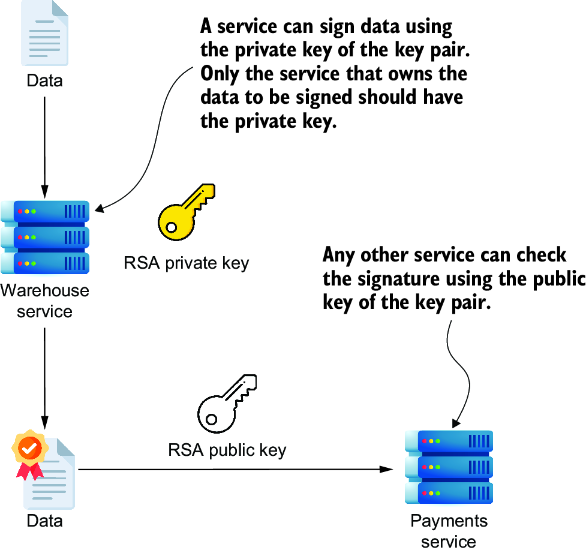
Trace the private-key signing and public-key verification flow between services. section 6.3.3




