Normal mapping makes a low-detail model appear richly textured by using bitmap colors to alter surface normals during shading. It changes the lighting calculation, not the underlying geometry, so a simple sphere can look brick-covered without adding quads or triangles. section 9.2.3
A brick-covered sphere
A brick normal texture applied to a sphere makes it look as though the surface contains thousands of quads, although the model still has only a few hundred. The example uses the simple UV mapping UV(x, y, z) = (x, y), projecting the sphere onto the x-y plane. section 9.2.3
Practical trade-offs include:
- Preserves economical geometry because added detail exists only in shading. section 9.2.3
- Depends on UV parameterization, which has no single best solution for every model. section 9.2.3
Figure 9.12 Normal mapping affects the normal vectors only in the shading computation. It doesn’t add any “real” geometry to the scene.
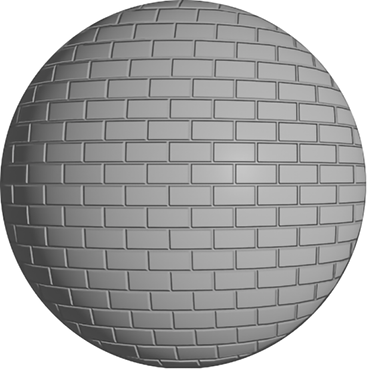
Shows that normal mapping changes normal vectors for shading while adding no real scene geometry. section 9.2.3
