liveBook · Manning

Normalized fitness

As explained in Advanced Algorithms and Data Structures

Normalized fitness is an individual's fitness divided by the sum of the fitness values of the population.

Normalized fitness converts an individual’s fitness into its share of the population total: fᵢ = fitnessᵢ / Σ fitness. The resulting value determines that individual’s proportion of a roulette wheel and therefore its selection probability. section 18.1.6

Using cumulative selection ranges

For a population, sum all fitness values, divide each fitness by that total, and accumulate the fractions in an array. Draw a random position on the interval; the range containing it selects the parent. Higher-fitness individuals receive larger ranges, while lower-fitness individuals retain a chance. Computing the total and percentages requires linear work per iteration. section 18.1.6

Figure 18.9 Roulette wheel selection in practice. We use an array with cumulative percentages; the difference between A[i] and A[i-1] is exactly the ratio between the i-th element’s fitness and the sum of all elements’ fitness.
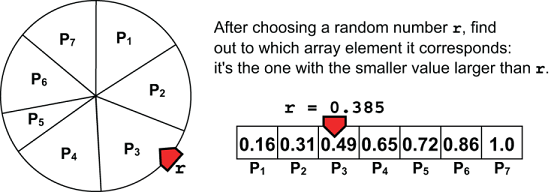
Use the cumulative-percentage diagram to trace how each individual’s normalized fitness becomes a selectable interval. section 18.1.6

How Advanced Algorithms and Data Structures covers it

How deep it goes
Defines the ratio, explains probability weighting, and details cumulative-array implementation without developing broader genetic-algorithm theory.
Examples
Uses a 0-1 knapsack population, roulette-wheel diagrams, and a cumulative-percentage array.
What it assumes
Assumes a population with fitness values and distinguishes maximization from cases requiring inverse fitness.
What you can do after
Apply roulette-wheel selection by computing normalized fitness and storing cumulative selection boundaries.
How it connects
Connects fitness, roulette-wheel selection, genetic algorithms, rank selection, tournament selection, and elitism.

This explainer was generated by Manning's knowledge graph from the text of Advanced Algorithms and Data Structures. The section links point to the parts of the book it draws on.