Novelty scoring estimates whether a therapeutic target is well established or relatively unexplored. In target discovery, it balances innovation potential against validation risk by combining publication counts, patent-landscape analysis, and clinical-trial history. section 13.2.3
A practical novelty assessment considers:
- Research saturation: how extensively the target appears in scientific publications. section 13.2.3
- Commercial competition: existing patents and prior investment around the target. section 13.3.1 section 13.2.3
- Clinical precedent: whether the target has already been pursued in clinical trials. section 13.2.3
- Biological support: evidence from multi-omics data, literature relationships, genetic associations, and disease-tissue expression. section 13.3.1
TNIK in idiopathic pulmonary fibrosis
TNIK represented a differentiated opportunity: few publications connected it to pulmonary fibrosis, no selective small-molecule inhibitors existed, and biological evidence supported its role in inflammatory and fibrotic signaling. After expert review, it became the lead target despite the higher validation risk associated with novelty. section 13.3.1
Figure 13.7 The four stages of the rentosertib program. Multi-omics data and literature flow through PandaOmics to a scored target list; Chemistry42 generates and optimizes candidates against a multi-objective reward; experimental readouts feed back to refine the models; clinical development follows. Sections 13.3.1 through 13.3.4 walk through each stage.
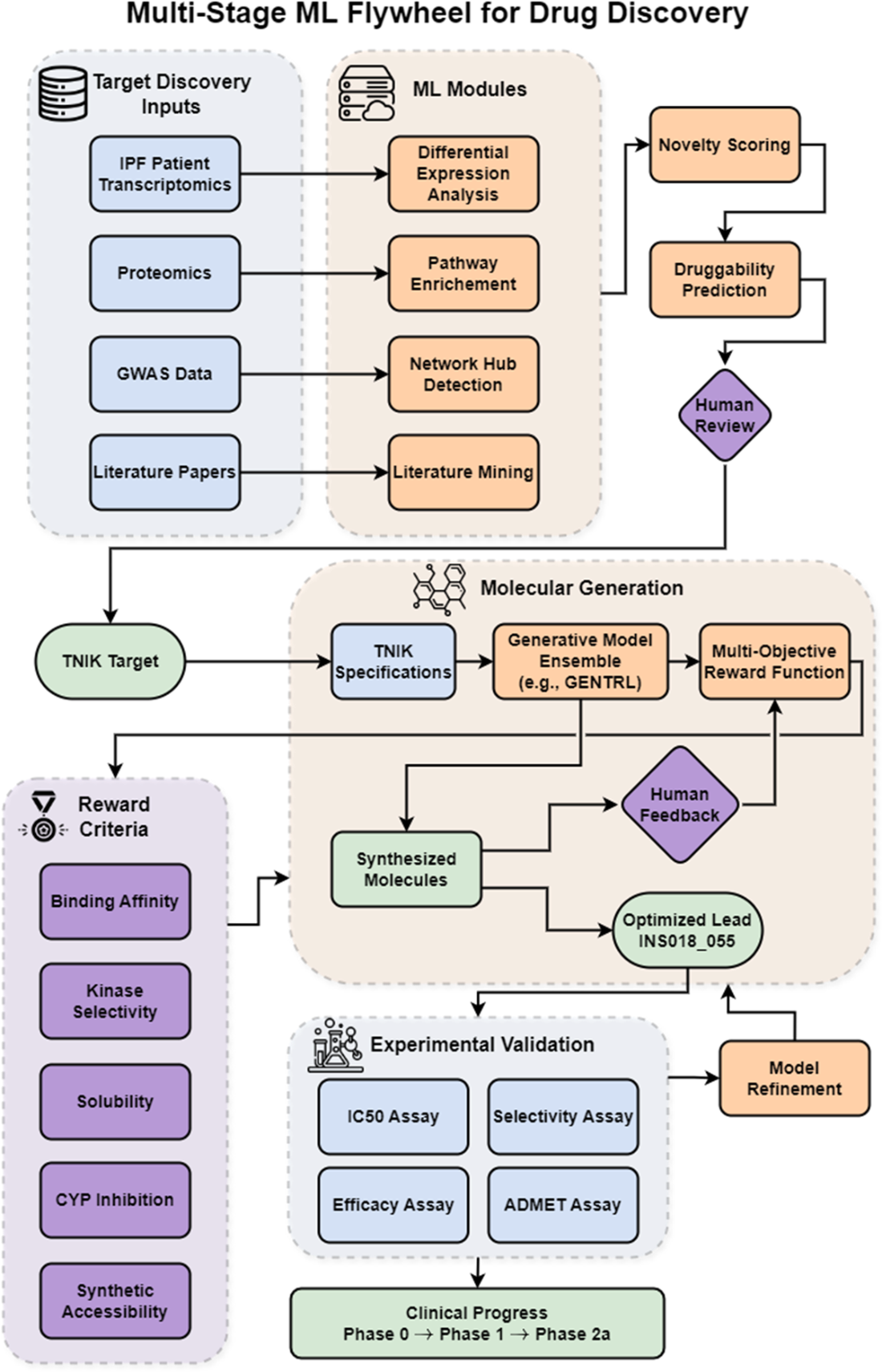
The end-to-end program view places novelty scoring within target discovery: integrated omics and literature produce a ranked target list before molecule generation and experimental feedback. section 13.3.1
