liveBook · Manning

Np-complete problem

As explained in Optimization Algorithms: AI techniques for design, planning, and control problems

The class of decision problems that are in NP and are at least as hard as every problem in NP.

An NP-complete problem is a decision problem that is both NP-hard and verifiable in polynomial time. Its solutions may be difficult to find, but proposed solutions can be checked efficiently. section 2.1.1

Use these classifications to distinguish computational difficulty:

  • P contains decision problems solvable in polynomial time by deterministic algorithms. section 2.1.1
  • NP contains problems whose solutions are hard to find but easy to verify in polynomial time. section 2.1.1
  • NP-hard problems are at least as hard as the hardest NP-complete problems and are commonly approached with approximation or heuristic solvers. section 2.1.1

Traveling salesperson problem

Selecting the best route through 13 cities illustrates the combinatorial search behind practical planning problems. Distance, time, or another criterion can define the preferred route; increasing the number of cities makes exact search difficult. section 2.1.1

Problem classes based on hardness and completeness. Problems can be categorized into NP-hard, NP-complete, NP, or P.
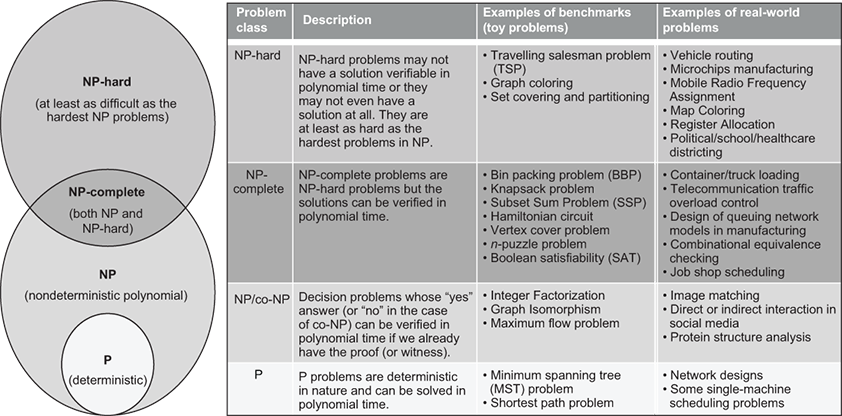
Compare P, NP, NP-complete, and NP-hard classifications in one visual hierarchy. section 2.1.1


How Optimization Algorithms: AI techniques for design, planning, and control problems covers it

How deep it goes
Defines NP-completeness through NP-hardness and polynomial-time verification, without developing formal proofs or exact algorithms.
Examples
Uses a 13-city traveling-salesperson route and combinatorial clustering as practical illustrations of large search spaces.
What you can do after
Evaluate whether exact search is practical and consider approximation or heuristic solvers for difficult optimization problems.
How it connects
Connects decision problems with P, NP, NP-hardness, polynomial time, approximation algorithms, heuristic solvers, and TSP.

Also explained in

Compare how 2 books explain np-complete problem →

Related concepts

This explainer was generated by Manning's knowledge graph from the text of Optimization Algorithms: AI techniques for design, planning, and control problems. The section links point to the parts of the book it draws on.