An NP-hard problem is at least as hard as the hardest problems in NP-complete, whether or not it is itself a decision problem. Exact efficient algorithms are generally difficult to find, so practical solutions often use approximation or heuristic solvers. section 2.1.1
The surrounding complexity classes clarify what NP-hard means:
- P contains decision problems solvable in polynomial time by deterministic algorithms. section 2.1.1
- NP problems may be difficult to solve but have solutions that can be verified in polynomial time. section 2.1.1
- NP-complete problems are both NP-hard and verifiable in polynomial time. section 2.1.1
Route selection and clustering
A traveling-salesman route through 13 cities requires selecting the best path according to distance, time, or another criterion. Similar combinatorial growth appears when grouping objects into clusters or organizing smart-cart collection points. section 2.1.1
Problem classes based on hardness and completeness. Problems can be categorized into NP-hard, NP-complete, NP, or P.
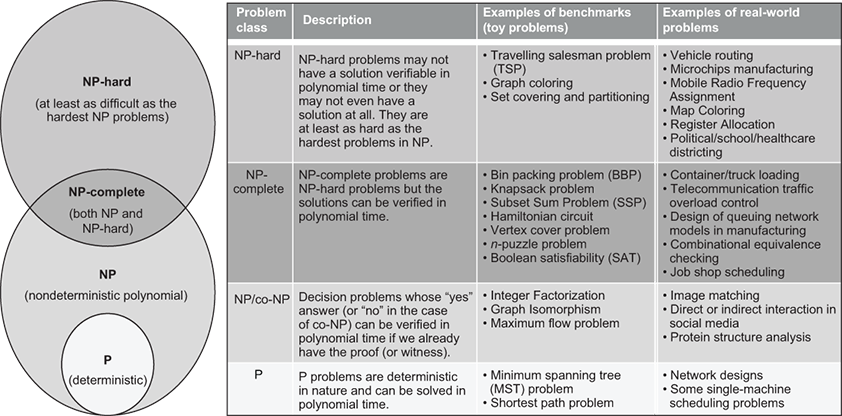
Use the problem-class diagram to compare P, NP, NP-complete, and NP-hard categories. section 2.1.1

