liveBook · Manning

NSGA-II

As explained in Evolutionary Deep Learning: Genetic algorithms and neural networks

NSGA-II is a multi-objective evolutionary algorithm that uses elitist non-dominated sorting and crowding to preserve diverse high-quality solutions.

NSGA-II is a multi-objective evolutionary algorithm and selection operator that balances fitness optimization with long-term population diversity. It is especially useful when evolution runs long enough for populations to specialize or become stuck. section 3.4

Use the selection experiment to inspect how NSGA-II behaves:

  • Set the population size to 1000 and run 15 generations to make differences between selection methods visible. section 3.4
  • Inspect the final evolution output and compare histogram shapes as indicators of population diversity. section 3.4
  • Contrast NSGA-II with best, worst, tournament, and SPEA2 selection when studying specialization and Pareto-front distribution. section 3.4
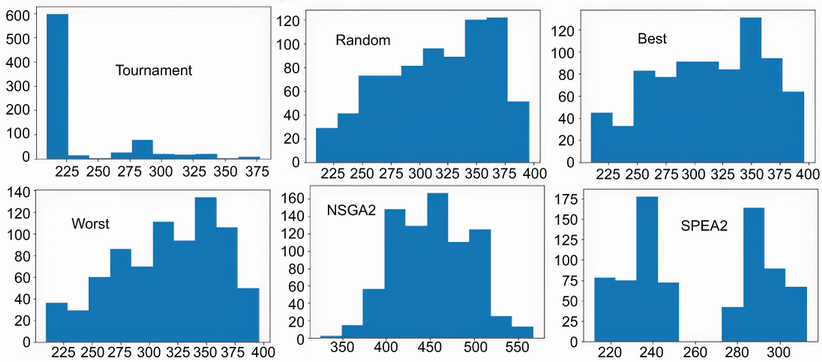
Figure 3.7 A comparison of selection operators on population diversity

Compare the population distributions produced by different selection operators, including NSGA-II. section 3.4

How Evolutionary Deep Learning: Genetic algorithms and neural networks covers it

How deep it goes
Defines elitist non-dominated sorting and crowding, then emphasizes observed diversity rather than deriving the algorithm formally.
Examples
Compares selection-operator histograms using populations of 1000 individuals evolved for 15 generations.
What you can do after
Apply NSGA-II in an evolutionary experiment and inspect whether its population remains diverse over longer runs.
How it connects
Connects NSGA-II to multi-objective optimization, Pareto fronts, selection operators, and population diversity.

Related concepts

This explainer was generated by Manning's knowledge graph from the text of Evolutionary Deep Learning: Genetic algorithms and neural networks. The section links point to the parts of the book it draws on.