NumbersAPI is a free public web API for facts about numbers. It can return trivia, math, date, and year facts as plain text or JSON, and its simple unauthenticated requests make it useful for practicing API retrieval and response parsing. For example, http://numbersapi.com/42?json requests a JSON fact for 42. section 4.1.1
Figure 4.1 Interacting with an API: This diagram shows how a client constructs a full request URL by combining a base endpoint with query parameters that define the data request (e.g., filters, limits, and format). The server receives the request, handles tasks like authentication and data lookup, and returns a structured JSON response. This client-server pattern is central to data engineering workflows, where APIs often serve as the primary source of external or cloud-based data. Knowing how to shape requests and interpret responses is essential for working with modern data pipelines.
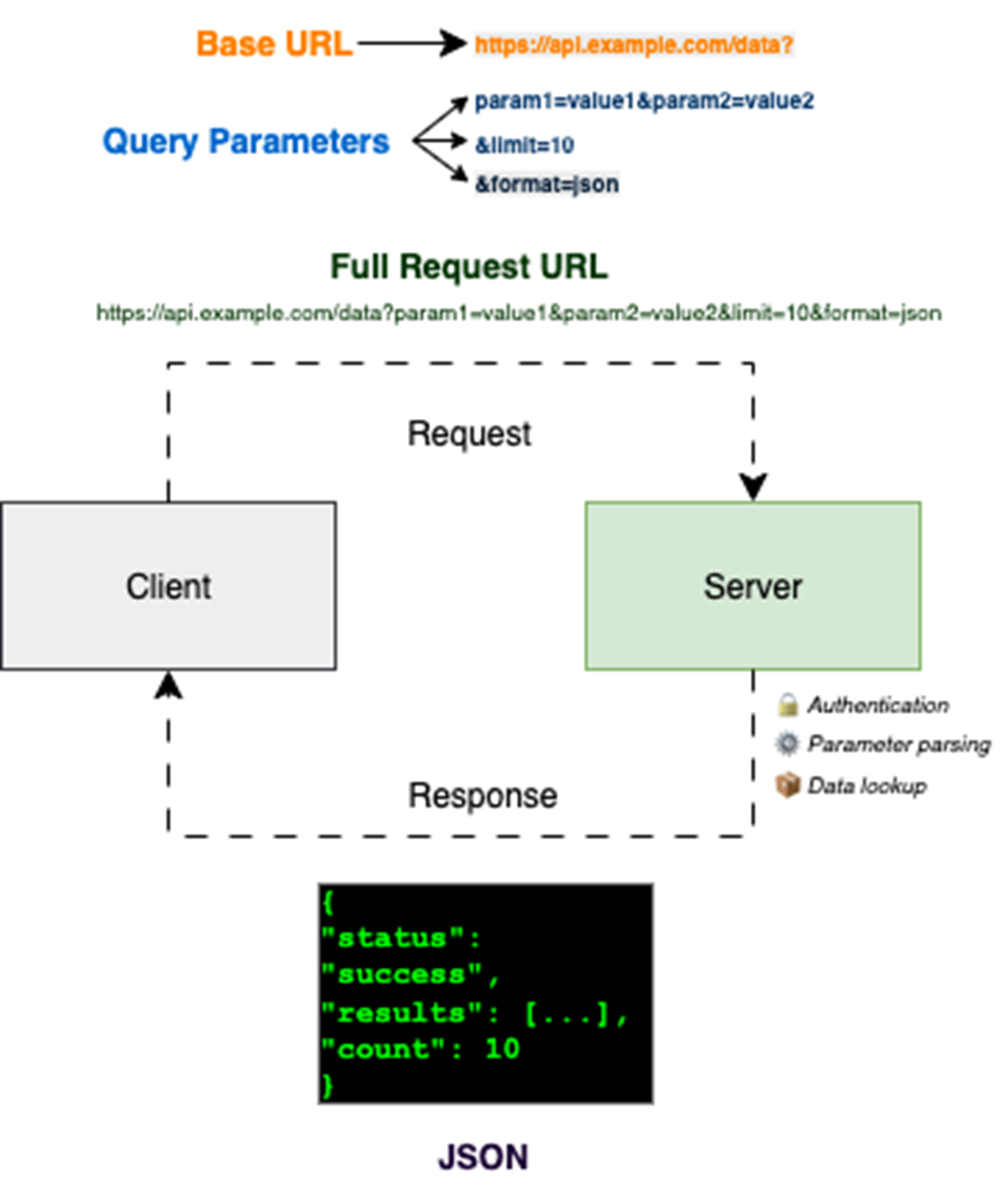
A client forms a request URL from an endpoint and query parameters; the server returns structured JSON for the pipeline to interpret. section 4.1.1
A practical workflow loops through requested numbers, calls the endpoint with requests, checks the HTTP status, extracts the JSON text field, and collects Number and Fact records in a pandas DataFrame. Record failures alongside successful rows rather than silently dropping them. section 4.1.1
Fetch trivia facts with guarded requests
For each value in a list, request http://numbersapi.com/{number}?json. On status 200, read text from response.json(); otherwise store an error status. Wrap the call in exception handling, log outcomes, and add a timeout and up to three attempts when reliability matters. section 4.1.1
Documentation-aware requests can use /{number}/trivia?json=true¬found=floor&fragment=true. The notfound=floor option handles unavailable values gracefully, while fragment=true returns concise embeddable text. A single routine can also accept random with fixed values and return all results together. section 4.1.2
Parse a structured response
A JSON response includes text, number, found, and type. Preserve number, text, and found in DataFrame columns so downstream analysis can distinguish returned facts from unresolved requests. section 4.1.1