A NURBS model represents curves and surfaces with arrays of control points, weights, knot vectors, and polynomial basis functions. It generalizes Bézier curves, giving direct control over shape, interpolation, continuity, and position. This makes it useful for CAD, computer-aided engineering, games, geoinformation systems, and manufactured surfaces. section 7.0 section 7.3
Four parts explain the practical behavior of a NURBS model:
- Basis splines combine scaled polynomial basis functions of a shared degree. Higher degree increases continuity but reduces the number of curve segments produced by a fixed set of control points. section 7.3.1
- Nonuniform knot vectors assign parameter intervals to segments. Repeated knots can skip a segment and make selected control points lie on the curve. section 7.3.2
- Rational weighting adds control beyond ordinary polynomial splines, supporting engineering curves and exact conic-related shapes and surfaces. section 7.3.5 section 7.6
- Spline composition joins simpler functions into a compound curve that can use many control points without suffering from the Runge phenomenon. section 7.3.5
Evaluating a NURBS circle
A quadratic NURBS circle uses control-point coordinates, alternating weights of 1 and 1/√2, and the knot vector [0, 0, 0, 1, 1, 2, 2, 3, 3, 4, 4, 4]. De Boor’s algorithm finds the knot interval for parameter t, recursively blends the relevant control values, and divides by the final weight. The implementation stores these coordinates in homogeneous form before returning the planar point. section 7.3.4
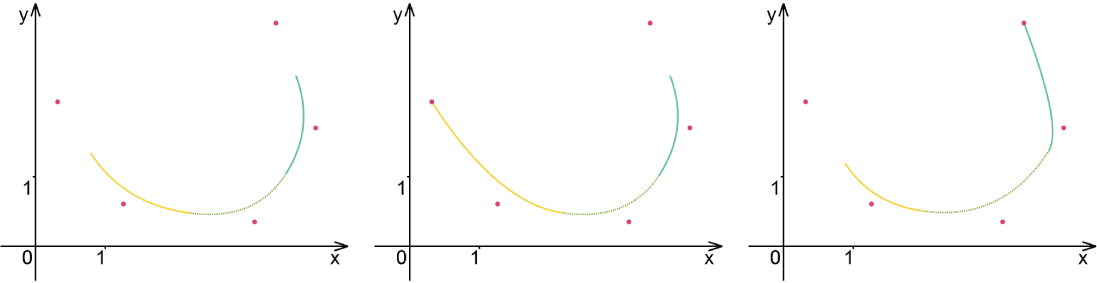
Compare identical control points under different knot vectors to see how uniformity, repeated knots, and parameter spacing change interpolation and shape. section 7.3.2
