NVIDIA Triton Inference Server is an open-source inference-serving system for deploying models across CPUs, GPUs, cloud infrastructure, data centers, and edge applications. It accepts remote inference requests over REST or gRPC and can also be embedded at the edge through a C API. section 7.4.3
Triton separates request handling from model execution. A filesystem-based model repository supplies model files; each model receives a configurable scheduler that can batch requests before passing them to a framework-specific backend. section 7.4.3
Use Triton when the serving system needs:
- One serving platform for models from TensorFlow, TensorRT, PyTorch, ONNX, XGBoost, and other frameworks. section 7.4.3
- GPU throughput and utilization improvements through concurrent execution and dynamic batching. section 7.4.3
- A model-server approach that reduces development and maintenance effort across multiple model types. section 7.7
Integrating Triton behind an existing prediction API
Keep the public prediction interface and cloud model storage unchanged by placing Triton Kubernetes pods behind the existing API. Give the pods a shared model repository, then use a sidecar to download models from cloud storage, register them with Triton, and translate incoming requests into Triton API calls. section 7.4.5
Figure 7.10 Triton Inference Server high-level architecture (Source: NVIDIA Developer, https://developer.nvidia.com/nvidia-triton-inference-server)
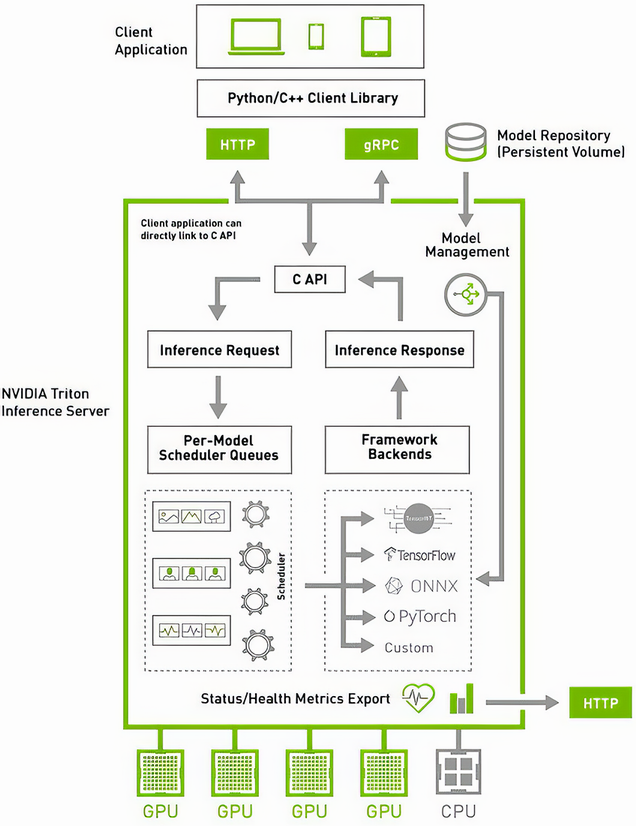
Use the architecture diagram to trace requests from REST or gRPC entry points through model schedulers and backends. section 7.4.3

