An object detection model identifies object instances and estimates their locations in visual input. In a production identity-card workflow, it turns a labeled image dataset into a detector that can recognize classes absent from its original training data. section 2.1.3
A practical detector workflow includes:
- Start with a pretrained YOLO model, whose COCO-trained classes do not include identity cards or passports. section 2.1.3
- Fine-tune YOLOv8 using a well-labeled identity-card dataset. section 2.1.3
- Separate images for training, testing, and validation, then use the training library's evaluation logic. section 2.1.3
Identity-card detection
A COCO-trained YOLO model cannot detect identity cards out of the box. Fine-tuning YOLOv8 on labeled identity-card images adapts the detector to that target class. section 2.1.3
Figure 2.5 A view of a retraining pipeline using the modular codebase concept. This approach of keeping the model, code, configuration files, and data as distinct versioned components with lineage links ensures that the process remains flexible, fast, and adaptable while enabling experimentation, debugging, and iterative development.
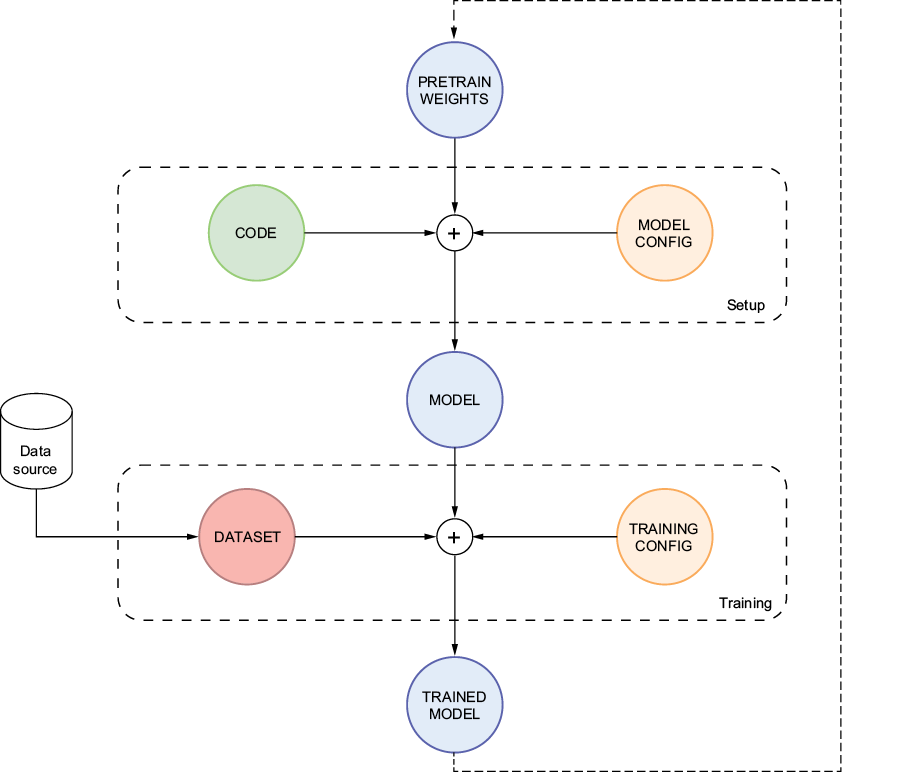
A modular retraining pipeline keeps the model, code, configuration, and data as distinct versioned components linked by lineage, supporting experimentation, debugging, and iterative development. section 2.1.3

