Observation deliberately records behavior, interaction, events, and verbal or nonverbal cues as evidence about a situation. Facilitation uses observation not only to see what happens, but also to listen actively for underlying problems. section 5.1.1
Use observation to make group dynamics and organizational problems more visible:
- Compare spoken claims with behavior and body language. Tense posture or avoided eye contact can contradict verbal assurances; these conflicting signals are double signals. section 5.1.1
- Record concrete signals rather than interpretations: halted movement, many clarifying questions, frowning, raised voices, silence, or repeated watch-checking. section 8.3 section 10.3.3
- Stay neutral when reporting what you notice, and treat signals as context-dependent rather than universally meaningful. section 10.2.2
- Agree on criteria with the group so an observation leads consistently to an action, such as a sensemaking exercise when more than three participants report confusion. section 10.3.3
Recognizing a hidden problem
A department leader says the back office is not a priority, but avoids eye contact and sits tensely. Frequent downtime, delayed customer responses, and clerical errors provide additional evidence. Record these observations without diagnosing motives, then decide with the group what response they warrant. section 5.1.1
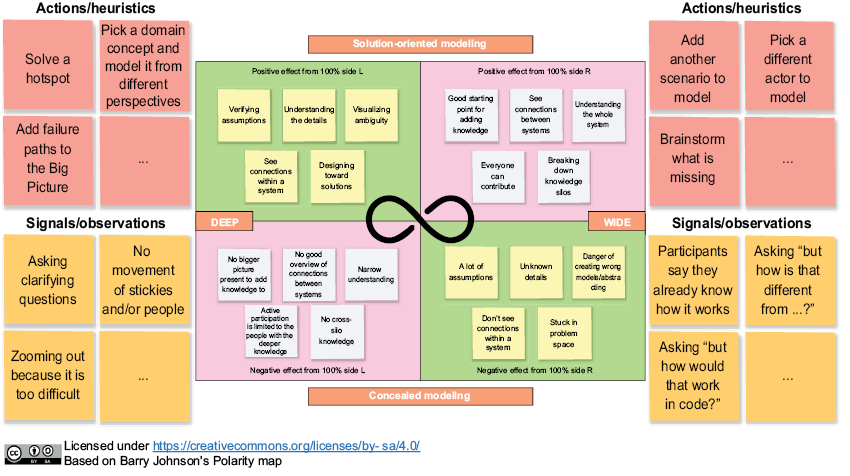
A polarity map connects observed signals to actions, helping a group decide when to move between approaches such as going deep and spreading wide. section 10.2.2
