Occam’s razor prefers the simplest model when alternatives offer roughly equivalent performance. In machine learning, that usually means fewer parameters, smaller size, or greater compression relative to the training set. Simplicity is a selection criterion, not an excuse to ignore nonfunctional requirements: a less interpretable model may be justified when its performance advantage matters. section 8.3.4
Use the principle as a practical model-selection checkpoint:
- Compare candidate models with roughly equivalent effectiveness, then prefer the smaller or more interpretable option. section 8.3.4
- Record the tradeoff when a complex model is retained for materially better nonfunctional performance. section 8.3.4
- Use a complex model such as XGBoost as a baseline or denoiser when a simpler explainable model is required. section 7.3.4
Choosing a sensor-failure tree
A decision tree can split sensors by installation location or by age. Although both may divide the data effectively, the age split produces a pure branch when sensors older than 100 days always fail, so it supports a simpler tree with no further test on that branch. section 7.3.4
Figure 7.5 Splitting the data using the age attribute to yield a pure node on the left branch. No further tests are required on this tree.
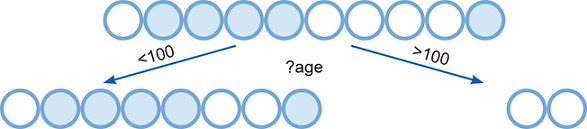
Inspect the age-based split that yields a pure node and demonstrates how a simpler tree can stop branching earlier. section 7.3.4


