ODBC (Open Database Connectivity) is a widely adopted standard interface for connecting analytical and business applications to structured data sources and executing queries. In a lakehouse, query engines or federation layers expose ODBC endpoints so familiar tools can access governed data without bespoke integrations. section 9.3.1 section 8.2.3
ODBC supports architecture goals while imposing practical tradeoffs:
- Connects BI tools, reporting applications, and spreadsheets such as Excel, Looker, Tableau, and Power BI through established drivers. section 8.2.3 section 9.3.1
- Centralizes access through query or federation engines, allowing consistent access policies, metric definitions, and query optimizations. section 9.3 section 9.3.1
- Handles synchronous, tabular workloads well but can struggle with high-volume transfers and streaming, while requiring driver configuration and management. section 9.3.1
Lakehouse access through ODBC
An analyst uses Excel or Looker to query an ODBC endpoint exposed by Trino, Dremio, or Spark SQL. The engine presents Iceberg tables through a relational-style interface; a federation layer can route the query across sources while enforcing centralized policies. section 9.3.1
Figure 9.2 JDBC/ODBC has a large ecosystem of drivers for systems from which you can pull data. This allows you to connect to tools like Dremio and Trino to pull data from your Apache Iceberg lakehouse.
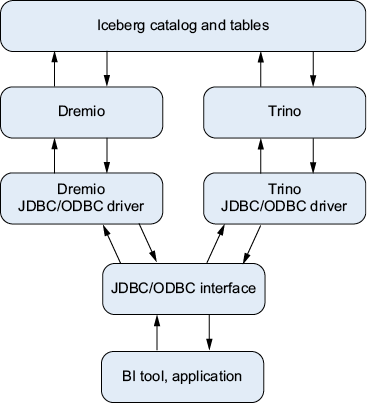
Shows how ODBC and JDBC drivers connect consumption tools and query engines to an Apache Iceberg lakehouse. section 9.3.1
