Odds compare how likely an event is with how likely its complement is. Like betting odds, they express a ratio rather than a direct probability: p/(1 − p). section 7.1.3
In binary classification, the logit is the logarithm of the odds. Logistic regression models these log-odds as an intercept plus a weighted combination of input features, then maps them back to probabilities with the sigmoid function. section 7.1.3
Odds make logistic-regression coefficients interpretable:
- A positive feature weight increases the odds of the positive class. section 9.1.3
- A negative feature weight decreases the odds. section 9.1.3
- Exponentiating a weight converts its change in log-odds into an odds multiplier. section 9.1.3
Diabetes diagnosis
If increasing age by one year raises log-odds by 0.5, the odds multiply by e^0.5, or about 1.65— a 65% increase. A glucose coefficient of −0.29 multiplies the odds by about 0.75, a 25% decrease. section 9.1.3
Figure 9.5 Interpreting a logistic regression, that is, a linear model for classification, for breast cancer diagnosis. Positive feature weights lead to increased odds of breast cancer, negative feature weights lead to decreased odds of breast cancer, and zero feature weights don’t affect the odds of breast cancer.
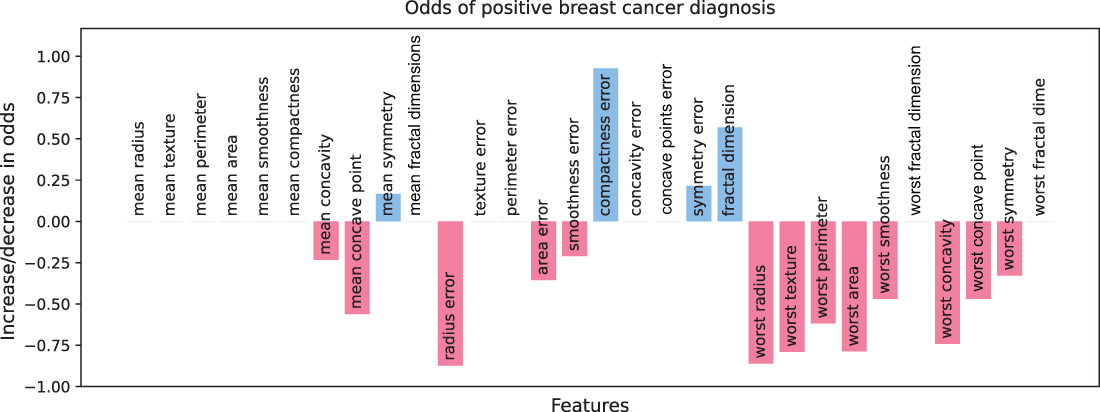
Use the figure to compare positive, negative, and zero feature weights through their effects on breast-cancer odds. section 9.1.3


