Offensive security proactively simulates real-world attacks against systems, applications, and networks to find exploitable weaknesses before malicious actors do. Its common forms include penetration testing, red teaming, vulnerability assessment, and ethical hacking. The result is actionable evidence for defensive teams to patch vulnerabilities and improve their processes. section 1.1
The work is an adaptive workflow rather than a one-time scan. Attack surfaces, software, and available signals change continually, while manual testing cannot explore every attack vector. AI-assisted workflows add contextual reasoning: they can correlate weak signals during reconnaissance and revise a proposed approach when an attempted payload fails. This makes exploration more responsive, but it must remain a controlled experiment with explicit operational boundaries. section 1.1 section 1.3.2
Operate offensive security under a discipline that protects systems, people, and evidence:
- Test only assets covered by explicit written authorization and a predefined scope. section 1.1.2
- Avoid destructive or intrusive production activity; use sandboxes, isolated networks, or explicit test environments. section 1.1.2
- Keep human review for actions that could cause data loss, disruption, or privacy violations, and comply with applicable law. section 1.1.2
- Protect sensitive telemetry through masking, redaction, secure handling, and deletion when no longer needed. section 1.1.2
- Log prompts, decisions, actions, and results for technical and legal auditability; disclose real vulnerabilities responsibly and allow remediation time. section 1.1.2
Reconnaissance agent
A reconnaissance agent can read system and network logs, reason about naming patterns, predict likely administrative endpoints, and refine its queries as it learns. During host enumeration, it can identify active hosts and flag a framework-specific pattern for configured follow-up or human validation. The example illustrates feedback-driven investigation, not unattended high-risk action. section 1.3.2 section 1.1.2
Figure 1.2 Seven best practices for offensive security. 1) Authorized scope only: to ensure we do not cause damage or expose sensitive information, we need to work within pre-defined, scoped boundaries. 2) No production harm: do not do things that will negatively affect production traffic. 3) Follow the law: we must stay compliant and follow regulations. 4) Human oversight: humans must be in the loop to review and validate findings. 5) Protect sensitive data: proper processes must be set up to ensure personal and identifiable information is not exposed. 6) Document everything: we must store logs, traces, and other artifacts that will allow us to audit our systems. 7) Reasonable disclosure: We should give the affected party a reasonable amount of time to fix issues before publicly revealing them. These best practices ensure that offensive security teams consistently deliver value and maintain professionalism within their organization.
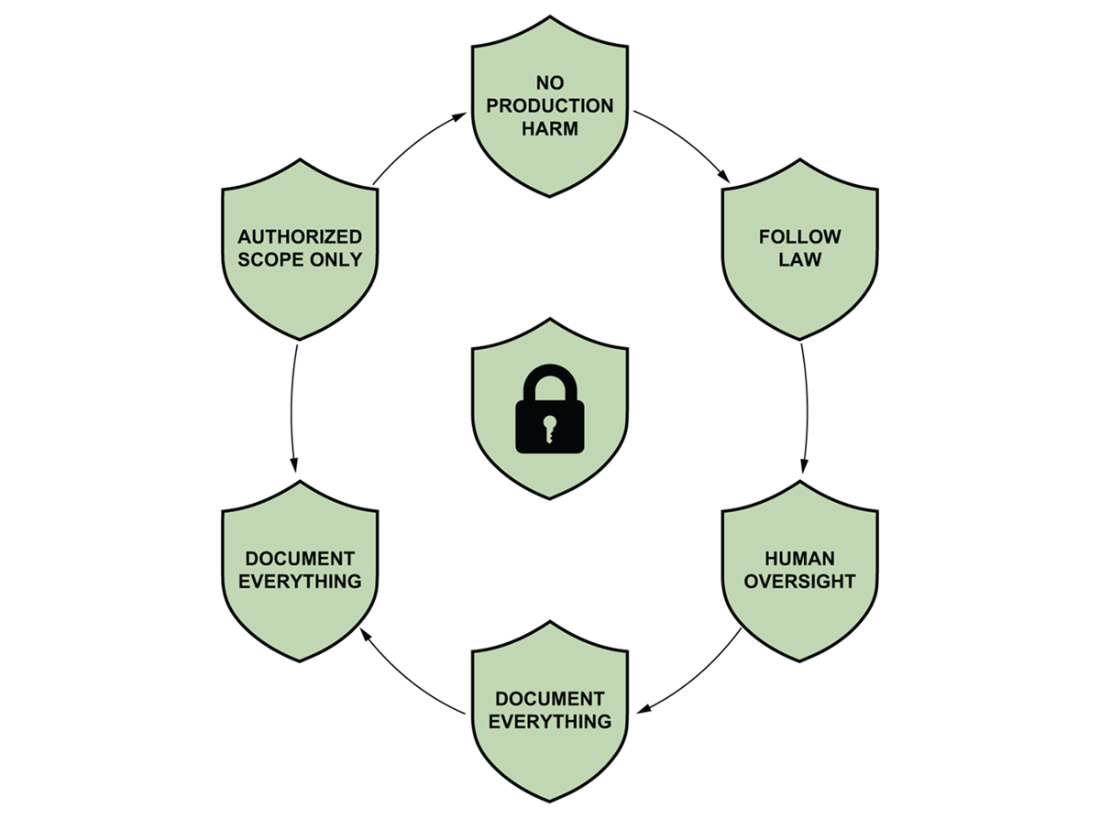
Use the seven-practice checklist to establish scope, safety, oversight, data handling, audit records, and disclosure rules before running a test. section 1.1.2
