Offline optimization performs the search before operation, allowing more time to obtain a high-quality solution when decisions do not need to be produced immediately. section 2.5 section 2.1.5
Its natural setting is design: strategic assignments or configurations can tolerate extended computation in exchange for better results. This contrasts with planning and control, where delays increasingly matter. section 2.5 section 2.1.5
Use the search-time trade-off to distinguish optimization settings:
- Design problems permit more processing time and generally prioritize solution quality. section 2.1.5
- Planning problems require solutions within seconds or minutes, so optimality is commonly traded for speed. section 2.1.5
- Control problems repeat optimization multiple times per second, making rapid computation more important than precision. section 2.1.5
Electoral district design
Electoral districts can be optimized offline as a constrained, multicriteria assignment problem. An objective function can combine population equality, compactness, socioeconomic homogeneity, community integrity, and similarity to existing districts, weighted by user-specified multipliers. section 2.1.5
Figure 2.12 Qualities of solutions vs. search time. Some types of problems require fast computations but do not require incredibly accurate results, while others (such as design problems) allow more processing time in return for higher accuracy.
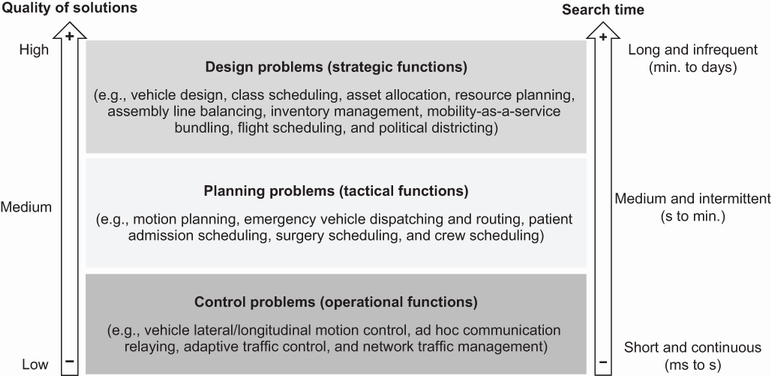
Compare how permissible search time changes the expected quality of solutions, especially for slower design problems. section 2.1.5
