Offspring are new candidate solutions produced from existing individuals in an evolutionary algorithm. Like biological offspring, they inherit a mix of traits from parents and can have small random changes. These variations give the algorithm new possibilities to test. section 4.1 section 4.11
In a genetic algorithm, offspring enter the search through a repeating life cycle:
- Score candidate solutions with a fitness function, then select parents based on fitness. section 4.3
- Combine parts of the parents through crossover, then introduce small random changes through mutation. section 4.11
- Select individuals and offspring to survive into the next generation, then repeat the process. section 4.3
Two-point crossover
Suppose two binary parents are split after their second and fourth positions: 11 | 00 | 11 and 00 | 11 | 00. Taking the first and last parts from the first parent and the middle part from the second produces 11 | 11 | 11. Reversing the choices produces a second offspring, 00 | 00 | 00. Mutation can then change offspring to introduce further variation. section 4.13 section 4.11
Figure 4.21 Two-point crossover
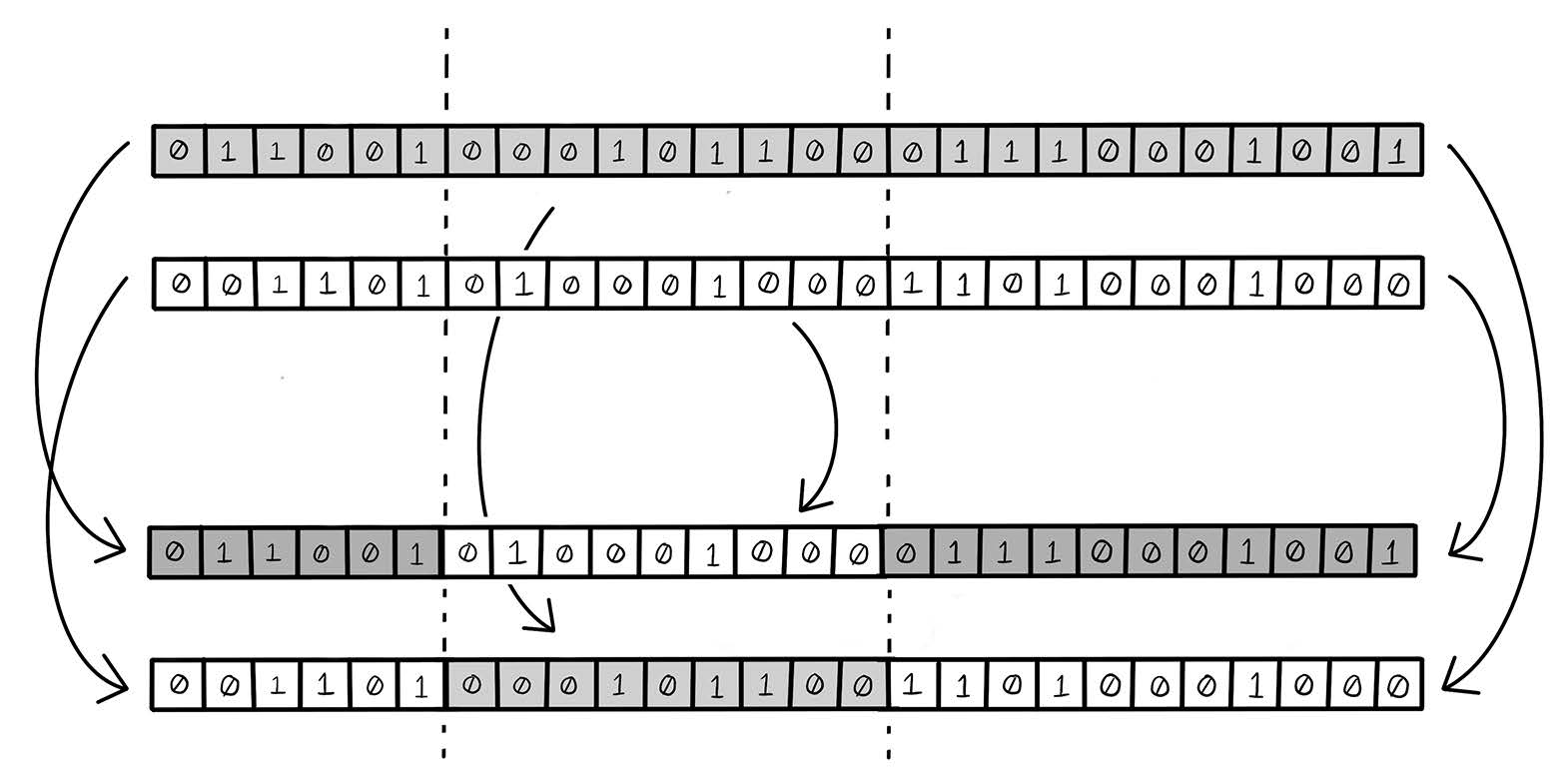
The diagram shows how two crossover points divide the parents into parts for creating offspring. section 4.13
The number of offspring is a configurable trade-off. More offspring can increase diversity, but in a fixed-size population they can displace good solutions. Crossover and mutation must also produce valid solutions for the problem. In a steady-state model, offspring replace only part of the population; in a generational model, they replace the whole population. section 4.20 section 4.9

