The old generation is the heap region for objects that survive long enough in Survivor regions to be promoted for long-term use. Because it holds longer-lived objects, garbage collection cleans it less often than Eden. section 11.1
Use old-generation behavior as a diagnostic signal when reading GC logs:
- Track whether objects move from Eden through Survivor regions into the old generation. section 11.1
- Compare old-generation occupancy before and after collections; frequent full collections may indicate memory pressure or a leak. section 11.5
- Interpret old-generation patterns alongside pause times and heap utilization rather than treating one GC event as a complete diagnosis. section 11.5
Reading an old-generation entry
A log line such as “Old regions: 0->0” shows that a collection left the old-generation region count unchanged. The same event moved Eden regions from 4 to 0 and Survivor regions from 0 to 1, indicating a young-collection transition without promotion into the old generation. section 11.1
A visual representation of heap memory management illustrates how the heap is structured and how objects are organized based on their life cycle. The heap is divided into multiple regions, where objects are stored according to their age, which is determined by the number of GC cycles they have survived. As objects persist through successive GC cycles, they may be promoted from one region to another, optimizing memory usage and performance.
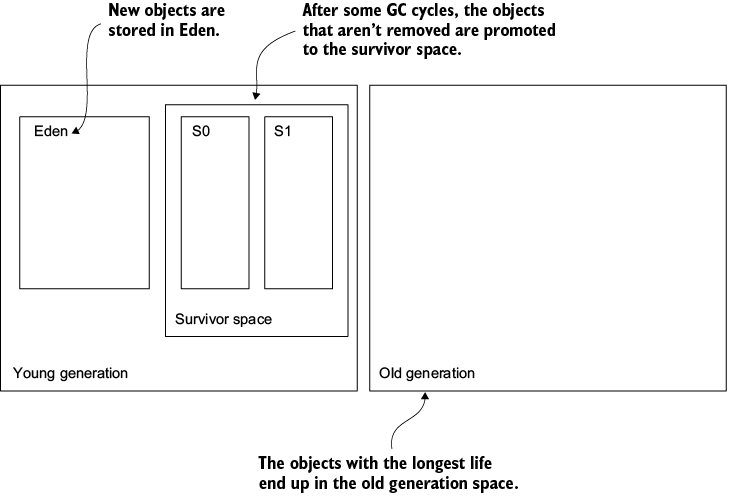
Use the heap-lifecycle illustration to follow how object age and repeated GC survival determine movement between Eden, Survivor, and old-generation regions. section 11.1
