Ever know exactly what you want, but struggle to describe it? One-shot prompting helps by giving a language model one example before the task. The example demonstrates the expected structure or style, making the request clearer than instructions alone. section 3.2.2
A format example
Example: Electric Vehicle: Low maintenance, lower fuel costs, quieter operation. Now describe a hybrid vehicle using the same format. The model can use the example as a pattern for the requested response. section 3.2.2
Use one-shot prompting as a simple escalation path:
- Start with zero-shot prompting when a task description is enough. section 3.2.2
- Add one example when the response is inconsistent or the desired format is difficult to explain. section 3.2.2
- Provide several examples when the task remains ambiguous or requires a more reliable pattern; this becomes few-shot prompting. section 3.2.2
Figure 3.4 Three common prompting approaches. In zero-shot prompting, the model receives only a task. In one-shot prompting, a single example is provided. In few-shot prompting, multiple examples are provided to establish a clearer pattern.
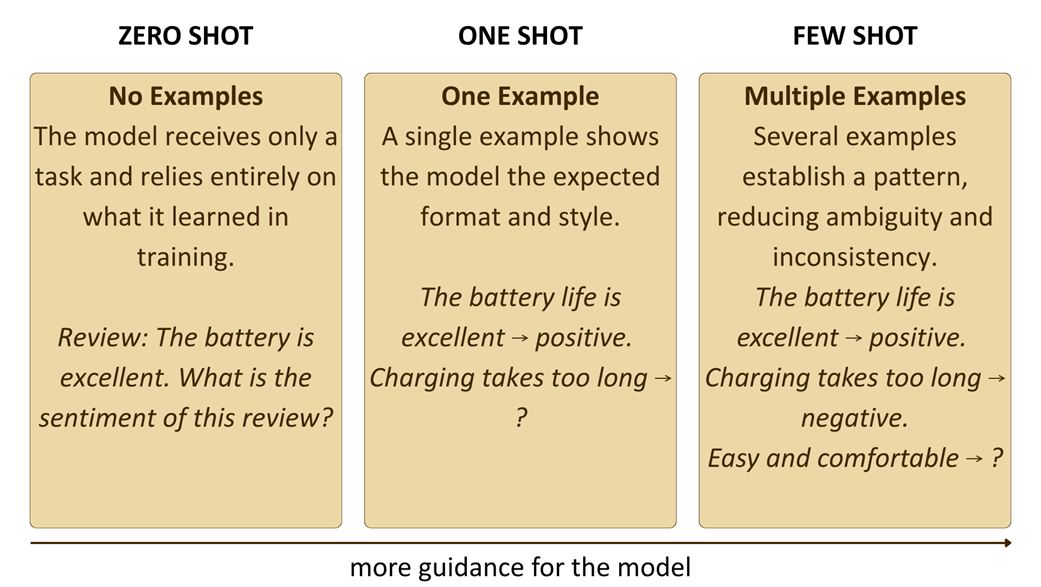
Compare zero-shot, one-shot, and few-shot prompting by the number of examples supplied before the task. section 3.2.2
One example can clarify what words leave underspecified, but it does not remove the need to evaluate the output. Prompt quality, verification, and human oversight still matter. section 3.5