A cryptographic hash function has the one-way property when its output does not feasibly reveal the original input. This lets a fixed-size hash represent data without making the data recoverable from the hash alone. section 4.2.1
Keep the property distinct from related hash-function behavior:
- Hashing is deterministic: the same input always produces the same output. section 4.2.1
- One-wayness concerns recovering an input from its output; collision resistance concerns finding different inputs with the same output. section 4.2.1
- Use standardized, peer-reviewed cryptographic hash functions rather than designing one. section 4.2.1
Figure 4.3 Think of the hash function as a blender: it takes inputs of different sizes and produces outputs of the same size. Different input values produce different output values. Attackers who access the hash value can’t determine anything about the input.
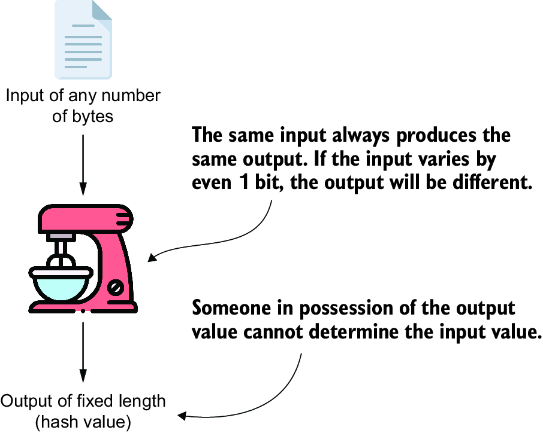
The blender analogy illustrates how inputs of different sizes produce fixed-size outputs while remaining infeasible to recover from the hash. section 4.2.1
