Online optimization performs optimization during operation, producing decisions within a limited execution time. It suits control tasks requiring solutions from milliseconds to a few seconds and repetitive planning tasks affected by continually arriving information. section 2.5 section 2.1.5
Online optimization prioritizes timely, repeatedly updated decisions:
- Control problems may accept slightly less accurate solutions because the optimization runs again during the next cycle. section 2.1.5
- Planning problems can require repeated rescheduling as new orders arrive, balancing solution quality against delays. section 2.1.5
- The approach contrasts with slower design optimization, where more processing time can support higher solution accuracy. section 2.5 section 2.1.5
MAV communication relay
After a victim is detected, a swarm of MAVs repeatedly repositions itself to maximize visibility and radio coverage while finding a short path to the base station. Because movement decisions recur multiple times per second, speed matters more than perfect accuracy; subsequent cycles can correct small errors. section 2.1.5
Figure 2.15 Communication relaying problem—a swarm of MAVs must form an ad hoc communication relay between a base station and a trapped victim. The movement of the MAVs is a control problem that must be solved repeatedly, multiple times per second. In this case, speed is more important than accuracy, as minor errors can be immediately corrected during the next cycle.
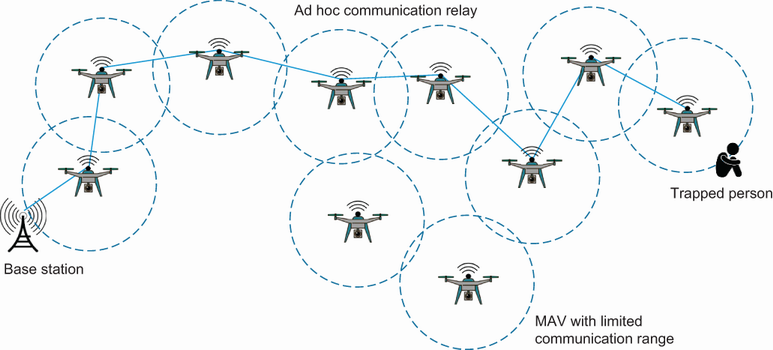
Use the communication-relay figure to see why repeated control cycles favor fast, adequately accurate optimization over one-time exact computation. section 2.1.5
