An onlooker bee is an agent in the artificial bee colony (ABC) algorithm. It chooses a candidate solution, called a food source, based on its quality and searches nearby for an improvement. The idea comes from honeybee foraging: onlookers observe dances that communicate where promising food sources are. section 10.4 section 10.5
In one ABC iteration, the roles work together:
- Employed bees search around their current food sources and share the resulting solution quality. section 10.5
- Onlooker bees choose sources probabilistically: better fitness gives a source a greater chance of selection. Each onlooker then evaluates a neighbor of its chosen source. section 10.5
- Scout bees replace sources that have stopped improving with newly discovered sources, adding exploration to the onlookers’ local exploitation. section 10.5
Choosing a source in a minimization problem
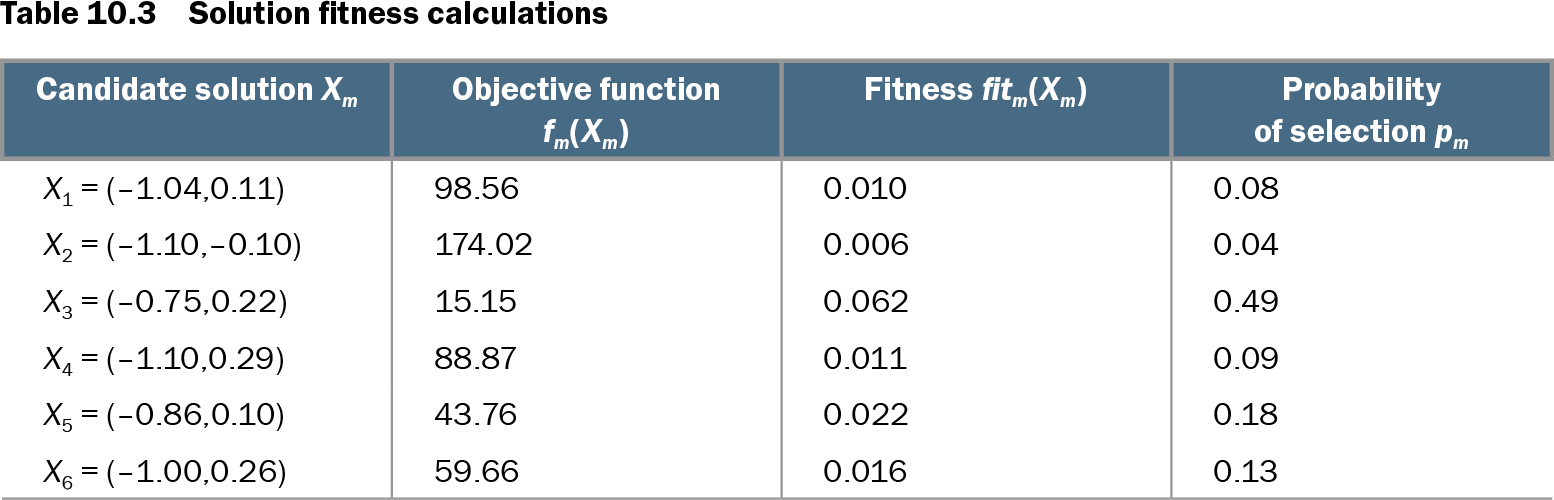
For six candidate solutions to the Rosenbrock function, one candidate has an objective value of 15.15 and a selection probability of 0.49. Another has an objective value of 174.02 and a probability of 0.04. The better candidate is much more likely to attract an onlooker, but the choice remains probabilistic. In the Python implementation, nonnegative objective values are converted to fitness weights using 1 / (1 + value), then normalized into selection probabilities. section 10.5
To experiment, run ABC on the two-dimensional Rosenbrock function and inspect both the best fitness and the selected position. The supplied implementations show a Python version and a MEALPY OriginalABC version. Selection favors promising sources; it does not by itself guarantee the global optimum. section 10.5 section 10.6
Table 10.3 Solution fitness calculations (view table figure)
| Candidate solution Xm |
Objective function fm(Xm) |
Fitness fitm(Xm) |
Probability of selection pm |
|---|---|---|---|
| X1 = (–1.04,0.11) |
98.56 |
0.010 |
0.08 |
| X2 = (–1.10,–0.10) |
174.02 |
0.006 |
0.04 |
| X3 = (–0.75,0.22) |
15.15 |
0.062 |
0.49 |
| X4 = (–1.10,0.29) |
88.87 |
0.011 |
0.09 |
| X5 = (–0.86,0.10) |
43.76 |
0.022 |
0.18 |
| X6 = (–1.00,0.26) |
59.66 |
0.016 |
0.13 |
Compare each candidate’s objective value, fitness, and selection probability to see how source quality influences an onlooker’s choice. section 10.5