Open banking securely exposes banking data and capabilities through APIs, allowing third-party applications to access customer accounts with user consent. section 10.1
It lets fintech applications provide account aggregation, budgeting, expense tracking, payments, and related services without requiring each provider to build banking infrastructure. section 10.0 section 10.1
From screen scraping to APIs
Before open banking APIs, users shared bank credentials with third-party applications. Those applications logged in as the customer and scraped account data, creating broad access and credential-storage risks. Open banking replaces this pattern with consent-based API access. section 10.1
Figure 10.1 In screen scraping, bank customers share their account credentials with a third-party application that uses those credentials to log in to the bank’s website by impersonating the customer.
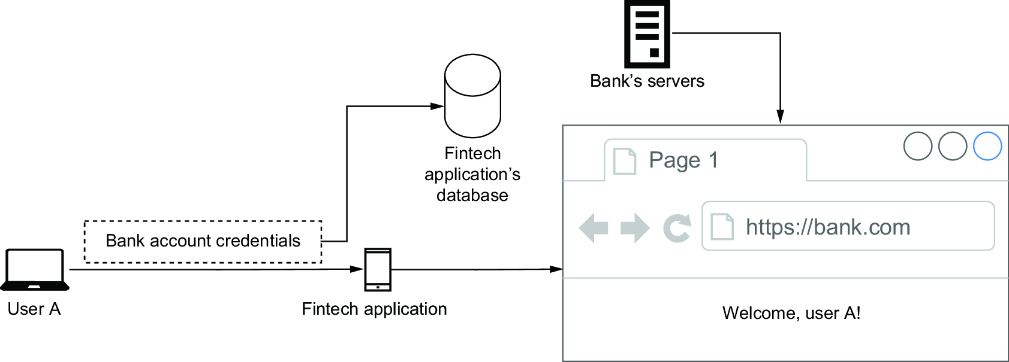
Visualizes how screen scraping requires customers to share credentials with an application that impersonates them at the bank. section 10.1
