Open Policy Agent
Open Policy Agent is an open-source policy engine that evaluates declarative policies against structured input to make authorization and other policy decisions.

Effective Platform Engineering
Open Policy Agent is an open-source policy engine that evaluates declarative policies independently of the application or infrastructure being governed.
- How it is used
- Provides policy decisions for point-of-change governance without requiring central ownership of development teams’ pipelines.
- How deep it goes
- Explains JSON inputs, Rego assertions, and admission-controller decisions with examples, while leaving agent deployment and policy publishing details aside.
- Examples
- Uses an age-based allow rule, a code-coverage threshold, and Kubernetes deployment-label checks.
- What you can do after
- Apply it via OPA and Rego to evaluate deployment requirements at an admission controller while preserving team-owned pipelines.
Read how Effective Platform Engineering explains Open Policy Agent →
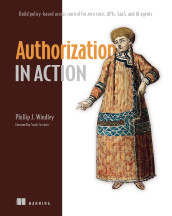
Authorization in Action
Open Policy Agent is an open-source policy engine that evaluates declarative policies to make authorization and other policy decisions.
- How it is used
- Applies portable policy decisions across APIs, Kubernetes, CI/CD pipelines, containers, gateways, and controllers.
- How deep it goes
- Explains Rego inputs and PARC elements in detail, then stops short of prescribing a built-in authorization structure.
- Examples
- Uses Kubernetes validation, API input restriction, admission control, CI/CD enforcement, and multi-platform infrastructure authorization.
- What you can do after
- Apply OPA and Rego to express portable policy logic over structured requests and infrastructure data.
Read how Authorization in Action explains Open Policy Agent →
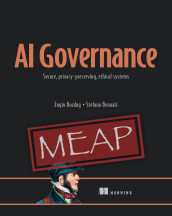
AI Governance
An open-source policy engine for defining and enforcing policy across software systems.
- How it is used
- Evaluates whether agent tool calls may send particular data under defined privacy policies.
- How deep it goes
- Explains purpose, necessity, and destination checks, but stops short of treating OPA as the call-interception layer.
- Examples
- Uses an agent-field-tool authorization question and a purpose-aware gate that can allow calls with redaction.
- What you can do after
- Apply OPA to decide whether an agent may send specified fields to a tool under explicit policy rules.
Also covered in
What to know first
- JSONJSON is a language-independent text-based data-interchange format that represents structured values using objects, arrays, strings, numbers, booleans, and null.
Related concepts
- policy enginekind of · A policy engine is a software component that evaluates policies against requests, resources, actions, or other inputs and produces decisions or enforcement outcomes.
- Regouses · Rego is a declarative query and policy language for expressing rules over structured data, commonly evaluated by Open Policy Agent and related systems.
- Gatekeeperused by · Gatekeeper is an open-source Kubernetes admission controller that validates and enforces policies using Open Policy Agent.
- HCP Terraformused by · HCP Terraform is HashiCorp's hosted software platform for managing Terraform workflows as a software service.
- policy serviceused by · A policy service is a software service that receives evaluation requests, applies declared policies, and returns authorization or enforcement decisions.
- service meshused by · A service mesh is an infrastructure layer that manages communication between distributed services and commonly provides traffic control, security, and observability.
Questions about Open Policy Agent
What is Open Policy Agent?
Open Policy Agent is an open-source policy engine that evaluates declarative policies against structured input to make authorization and other policy decisions.
Which Manning books explain Open Policy Agent?
Effective Platform Engineering, Authorization in Action and AI Governance.
What should I know before learning Open Policy Agent?
Manning books that teach Open Policy Agent usually introduce JSON first.
What is Open Policy Agent a kind of?
Open Policy Agent is a kind of policy engine. A policy engine is a software component that evaluates policies against requests, resources, actions, or other inputs and produces decisions or enforcement outcomes.
What is Open Policy Agent also called?
Open Policy Agent is also called OPA.
These guides are generated from the text of Manning books by Manning's knowledge graph and link to the sections they draw on. The full books are available on liveBook and at manning.com.