An OpenAPI tag is metadata attached to operations to group related API capabilities. Renderers use tag names for navigation, turning a flat operation list into an overview of concepts and use cases. section 19.2.2
Choose tags around concepts that cross resource boundaries or around user goals. A root-level tags list controls group order; without it, tools generally order tags as defined. Tags can clarify an API, but they cannot reorder operations to show a use-case sequence. section 19.2.2
Banking API transfer overview
Assign operations involving transfers, sources, and destinations to the shared “Concept - Transfer” tag. Add a “Modified by v1.2” tag alongside the default “All” tag when highlighting changed operations. For a use-case tag, add a Markdown description or externalDocs link when readers need the related workflow; otherwise, a Postman Collection may provide more useful request examples and testing. section 19.2.2 section 15.7.3 section 19.2.3
Figure 19.4 Group operations by adding tags. Sort groups by adding the root-level tags list. Operations can’t be reordered in groups.
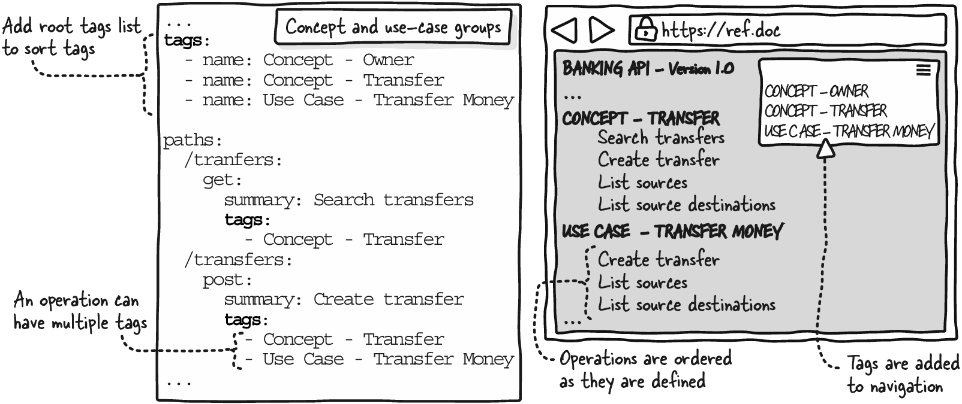
Use the grouping illustration to compare operation tags with root-level ordering and see the limitation on ordering operations within a group. section 19.2.2
When code generation matters, tags may also group generated operations into classes, modules, or files. Select or ignore tags deliberately, and pair them with unique operationId values when generated function names need to be predictable. section 19.5.2
