OpenBLAS is a threaded, optimized implementation of the BLAS and LAPACK interfaces used beneath NumPy. BLAS supplies operations such as vector addition and matrix multiplication; LAPACK builds higher-level algorithms such as singular value decomposition on top of them. section 4.3.1
OpenBLAS matters when tuning numerical Python workloads because its execution model affects resource allocation:
- Threading can substantially change CPU usage compared with nonthreaded Netlib implementations. section 4.3.1
- Combining multithreaded BLAS or LAPACK with process-level parallelism can overcommit CPU resources. section 4.3.1
- Checking NumPy’s linked libraries is necessary before choosing later optimization or parallelization steps. section 4.3.1
Check the linked numerical libraries
Run np.show_config() and inspect the reported BLAS and LAPACK entries. When the output is unclear, inspect shared-library links and package metadata to determine whether NumPy uses OpenBLAS, MKL, or another implementation. section 4.3.1
Install or select an implementation
With Anaconda, conda install numpy will commonly provide OpenBLAS. Standard pip installations may require an operating-system BLAS and LAPACK installation; avoid the slow, nonthreaded Netlib implementation when performance matters. Benchmark alternatives such as OpenBLAS and MKL when maximum performance is required. section 4.3.2
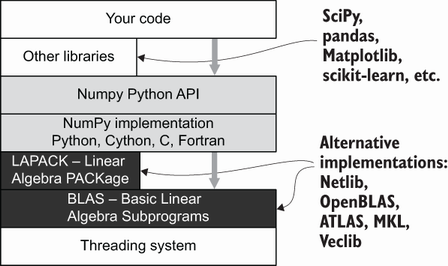
Use the NumPy dependency diagram to trace how Python-facing numerical operations connect to BLAS, LAPACK, and their implementations. section 4.3.1
