An RxJS operator is a function used to enhance an observable. Operators can manipulate, transform, or combine streams; `map`, for example, applies a function to every emission and produces corresponding new values. RxJS includes more than 100 built-in operators and permits custom operators for application business logic. section 5.2 section 5.4.1
Apply operators with an observable’s `pipe` method. Piping composes unary functions in execution order; in RxJS, the resulting operation works with `OperatorFunction`s and can accept multiple operators. section 5.4.2
Transform each emitted number
`of(1, 2, 3).pipe(map(x => x * 10))` emits `10`, `20`, and `30`. The `map` function runs once for each source emission. section 5.4.1
Operators commonly support reactive Angular work such as:
- Transforming or combining event streams. section 5.2
- Handling `HttpClient` observable results. section 5.2
- Reacting to reactive-form `valueChanges`, such as disabling an input after another value changes. section 5.2
- Representing state that changes over time and is shared between components. section 5.2
Figure 5.2 Marble diagram of the map operator
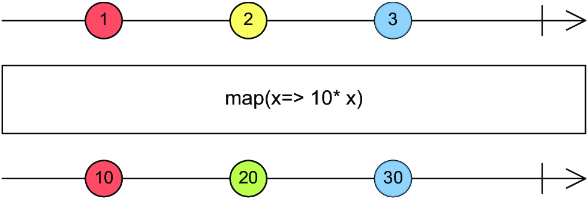
Use the marble diagram to visualize how `map` turns each source emission into a transformed output emission. section 5.4.1

