A user says “agent” as soon as a virtual assistant greets them. Another starts scheduling an appointment, then asks for a person after getting stuck. Both are opt-out requests: attempts to leave the automated interaction, often to reach a human agent. Users may also abandon the interaction by disconnecting. section 11.0 section 3.3.2
When the request happens matters. An immediate opt-out occurs before the user meaningfully engages; a later opt-out follows some participation and can often be traced to a task or step. The boundary depends on the conversation: in a simple question-and-answer assistant, an agent request in the first utterance is immediate. section 11.1 section 11.2
Look for different causes before choosing a response:
- Before engagement, a user may distrust automation after a poor experience or believe their problem is too complex for it. The request alone reveals little about which reason applies. section 11.1.1
- After engagement, a user may feel misunderstood, find a question unclear, lack requested information, or feel stuck in a loop. Check the step where the request occurred rather than assuming the user simply dislikes bots. section 11.1.2
An appointment flow
Suppose several users request an agent while providing address details. A total opt-out count shows containment loss, but not its cause. Recording the current task and exact step makes the cluster visible and gives the team a place to investigate. By contrast, requests during the initial greeting point toward an immediate opt-out problem. section 11.1.3 section 3.3.2
Figure 11.2 A breakdown of opt-out occurrences by step can aid in root cause analysis. In this chart, immediate opt-outs show prominently on the left, but trends indicate that there may also be a problem with collecting address details in multiple downstream flows.
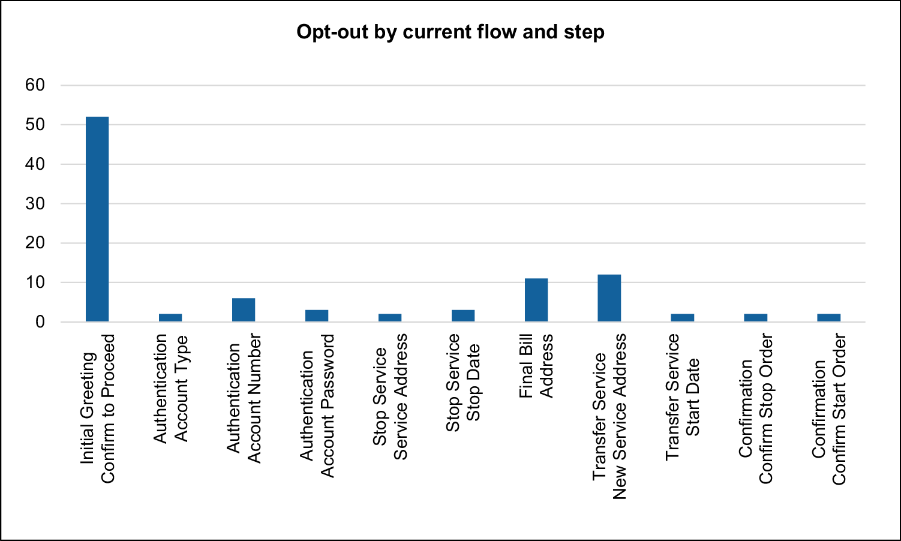
A step-level breakdown separates prominent immediate opt-outs from a possible address-collection problem across downstream flows. section 11.1.3
Track opt-outs as part of a detailed conversation-outcome model, not as a single undifferentiated failure count. Abandonment and an agent request mid-process can signal failure, while a transfer required by the business process may be a successful outcome. Use conversation logs and, where needed, flow markers to find where users leave; investigate the likely cause before changing the dialogue. section 3.3.2 section 11.1.3
