liveBook · Manning

Order crossover

As explained in Evolutionary Deep Learning: Genetic algorithms and neural networks

Ordered crossover combines parent sequences while preserving the relative order of selected elements.

Order crossover combines parent sequences while preserving the relative order of selected elements. It is examined as a genetic operator for permutation-based evolutionary problems such as a simplified traveling-salesman problem. section 3.4

A practical workflow swaps crossover operators in a DEAP-based Colab notebook, then uses visualizations to inspect how different operators affect evolving populations and genealogies. section 3.4

Operator comparison notebook

Run EDL_3_4_TSP_Operators.ipynb, choose crossover and selection options through Colab forms, and compare the resulting genealogy plots. section 3.4
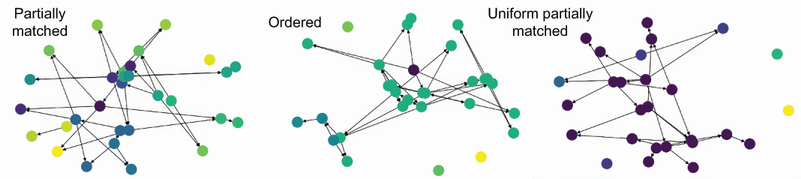
Figure 3.9 A comparison of genealogy plots of crossover operations

Compare genealogy plots produced by different crossover operations. section 3.4

How Evolutionary Deep Learning: Genetic algorithms and neural networks covers it

How deep it goes
Defines order preservation and inspects operator behavior experimentally, without detailing a step-by-step implementation.
Examples
Uses a simplified TSP, a Colab operator-selection notebook, and genealogy plots to compare crossover behavior.
What it assumes
Assumes familiarity with genetic operators and evolutionary populations while using a simplified TSP for experimentation.
What you can do after
Operate DEAP crossover choices through a Colab notebook and inspect their effects on evolving populations.
How it connects
Connects genetic algorithms with crossover, selection, mutation, DEAP, and the traveling-salesman problem.

Also explained in

Compare how 2 books explain order crossover →

Related concepts

This explainer was generated by Manning's knowledge graph from the text of Evolutionary Deep Learning: Genetic algorithms and neural networks. The section links point to the parts of the book it draws on.
