Order of continuity measures how many derivatives of a function remain continuous. A continuous function whose derivative is not continuous is C0; when its first derivative is continuous, it is C1; when its first and second derivatives are continuous, it is C2. More generally, Cn requires continuity through the nth derivative. section 5.2.1
For piecewise functions, continuity makes neighboring pieces meet at the same value. C1 smoothness additionally makes their derivatives agree, removing sharp corners. C2 smoothness also preserves continuous curvature, which is useful when joining engineered curves. section 5.2.1 section 5.2.4
Two piecewise joins
The pieces x² + 1 and 1 − x² meet at x = 0 with equal values and equal derivatives, producing a smooth join. By contrast, f(x) = x − 0.5 for x < 1 and f(x) = 1.5 − x for x ≥ 1 remains continuous but has a derivative mismatch and is not smooth. section 5.2.1
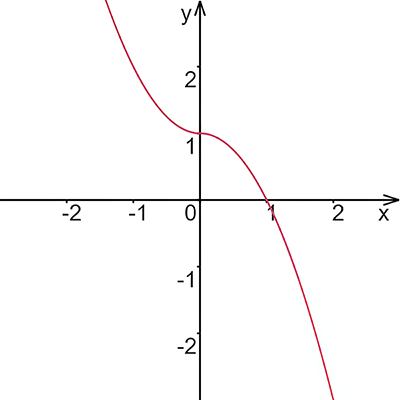
Compare the smooth C1 piecewise graph with the continuous but cornered graph in b2 to see how derivative matching changes geometry. section 5.2.1
