liveBook · Manning

Orientation

As explained in Robotics for Programmers

An orientation is the angular arrangement of an object relative to a reference direction or coordinate system.

Orientation describes an object's angular arrangement relative to a reference or coordinate system. Together with position, it determines the object's pose. section 6.1.1

Represent orientation as part of a uniform numeric pose:

  • A 2D pose can pair position (x, y) with orientation, while a 3D pose can use (x, y, z) plus orientation values. section 6.1.1
  • Pose parameters count the independent values needed to specify both position and orientation; a 3D object in 3D space may require up to six. section 6.1.1

Numeric robot pose

A robot pose such as position (5, 2, 0) with orientation (1.57, 0, -3.14) gives software numeric values for calculation rather than an informal description of location. section 6.1.1

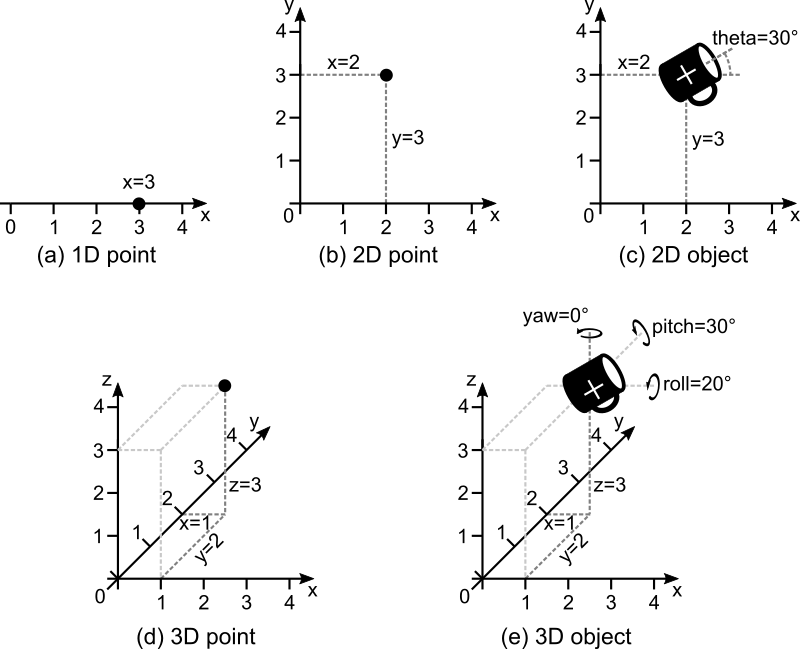
Figure 6.2 Spaces with 1D, 2D, and 3D dimensions require varying numbers of pose parameters (PP) to fully define an object’s position and orientation, with up to 6 PP needed for a 3D object in 3D space.
CH06 Fxx bihlmaier dimensions

Compare how 1D, 2D, and 3D spaces require different numbers of pose parameters to specify position and orientation. section 6.1.1


How Robotics for Programmers covers it

How deep it goes
Defines orientation within pose and numeric examples, then relates required pose parameters to space dimensionality.
Examples
Uses numeric 2D and 3D pose tuples and compares pose-parameter requirements across 1D, 2D, and 3D spaces.
What it assumes
Distinguishes position from orientation and introduces uniform numeric pose representation across spatial dimensions.
What you can do after
Evaluate robot poses using numeric position and orientation values suitable for software calculations.
How it connects
Connects orientation with pose, position, dimensions, coordinates, and reference systems.

Also explained in

Compare how 3 books explain orientation →

Related concepts

This explainer was generated by Manning's knowledge graph from the text of Robotics for Programmers. The section links point to the parts of the book it draws on.
