liveBook · Manning

OSPF message type

As explained in Acing the CCNA Exam: Volume 1 Fundamentals and Protocols

An OSPF message type is one of the protocol messages used for neighbor discovery, link-state database synchronization, or acknowledgment.

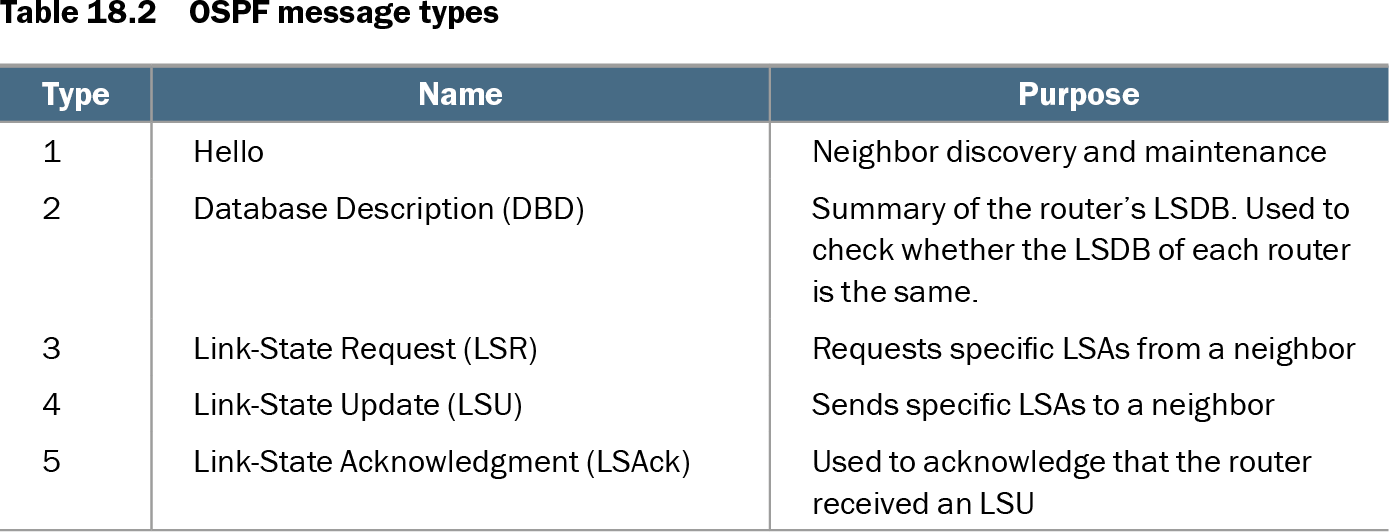
OSPF uses five message types to form neighbor relationships, synchronize link-state databases (LSDBs), exchange link-state advertisements (LSAs), and acknowledge delivery. section 18.3 section 18.5

Table 18.2 OSPF message types (view table figure)

Type

Name

Purpose

1

Hello

Neighbor discovery and maintenance

2

Database Description (DBD)

Summary of the router’s LSDB. Used to check whether the LSDB of each router is the same.

3

Link-State Request (LSR)

Requests specific LSAs from a neighbor

4

Link-State Update (LSU)

Sends specific LSAs to a neighbor

5

Link-State Acknowledgment (LSAck)

Used to acknowledge that the router received an LSU

Compare each message type by number, name, and operational purpose. section 18.3

Remember the message sequence and purpose:

  • Hello discovers and maintains neighbors. section 18.5
  • Database Description (DBD) summarizes a router’s LSDB. section 18.3
  • Link-State Request (LSR) requests specific LSAs. section 18.5
  • Link-State Update (LSU) sends specific LSAs. section 18.5
  • Link-State Acknowledgment (LSAck) confirms receipt of an LSU. section 18.5

How Acing the CCNA Exam: Volume 1 Fundamentals and Protocols covers it

How deep it goes
Defines all five message types and their purposes but does not detail packet fields or configuration commands.
Examples
Uses a table matching message numbers and names with neighbor discovery, LSDB summaries, LSA exchange, and acknowledgment.
What it assumes
Assumes basic OSPF terminology such as neighbors, LSDBs, and LSAs while linking messages to the neighbor-formation process.
What you can do after
Evaluate OSPF operations by identifying each message type’s role in neighbor formation and database synchronization.
How it connects
Connects message types to neighbor relationships, LSDB synchronization, LSAs, and OSPF neighbor states.

Related concepts

This explainer was generated by Manning's knowledge graph from the text of Acing the CCNA Exam: Volume 1 Fundamentals and Protocols. The section links point to the parts of the book it draws on.