An out-of-order event has a timestamp earlier than the preceding record. Kafka processes records by offset, so network delays or producer payload timestamps can make timestamp order differ from arrival order. section 9.2
In a windowed aggregation, an event arriving after its window closes may be excluded even though its timestamp places it inside that window. Kafka Streams handles this with grace: a configured period after closure during which such records remain eligible. section 9.2
Configure window handling according to the accuracy and lateness your application can tolerate:
- Use TimeWindows.ofSizeAndGrace to admit out-of-order records during a grace period after the window closes. section 9.2
- Use a WithNoGrace window constructor when records arriving after closure should be excluded. section 9.2
- Treat the grace duration as application-specific; longer grace can improve calculation accuracy but delays final acceptance of late records. section 9.2
A delayed event in a sales window
Suppose records for a sales window arrive in offset order, but one record carries an earlier event timestamp because a producer or network path delayed it. Without grace, the closed window drops it; with grace, Kafka Streams can include it in the aggregation. section 9.2
Figure 9.26 Grace is the amount of time you’ll allow out-of-order records into a window after its configured close time.
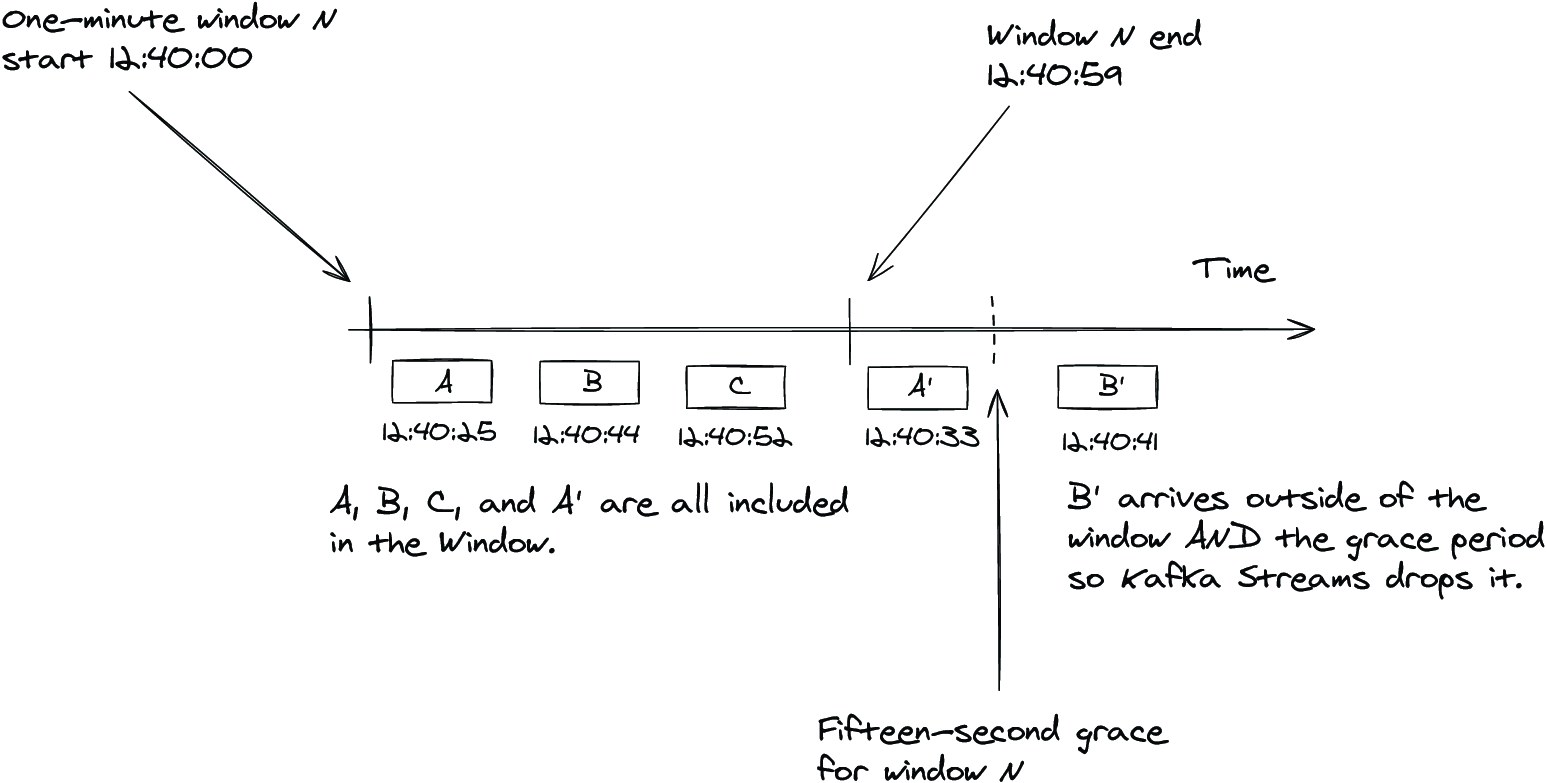
Shows grace as the interval during which out-of-order records remain admissible after a window’s configured close time. section 9.2
