--outfile is an optional command-line argument that sends generated text to a named file instead of standard output. Its short alias is -o. section 5.5.1 section 5.3
Choose an output-handling pattern based on how much work argparse should perform:
- Store a filename string with type=str and default='' when the program will decide how to open or write the destination. section 5.5.1
- Use type=argparse.FileType('wt') with default=sys.stdout to receive an open writable text handle for either a file or STDOUT. section 13.1 section 13.3
- Write to STDOUT when the option is absent; supply the filename after -o or --outfile when redirecting output. section 5.3
Redirecting Howler output
Running ./howler.py -o out.txt ../inputs/fox.txt produces no terminal output. Reading out.txt afterward shows the uppercased sentence: THE QUICK BROWN FOX JUMPS OVER THE LAZY DOG.
A reusable output destination
A generated song can default to STDOUT or accept -o song.txt. With type=argparse.FileType('wt') and default=sys.stdout, later code can write to the same output handle in either case. section 13.1 section 13.1.5
Figure 5.5 A string diagram showing that our howler.py program will accept strings or files as inputs and possibly an output filename.
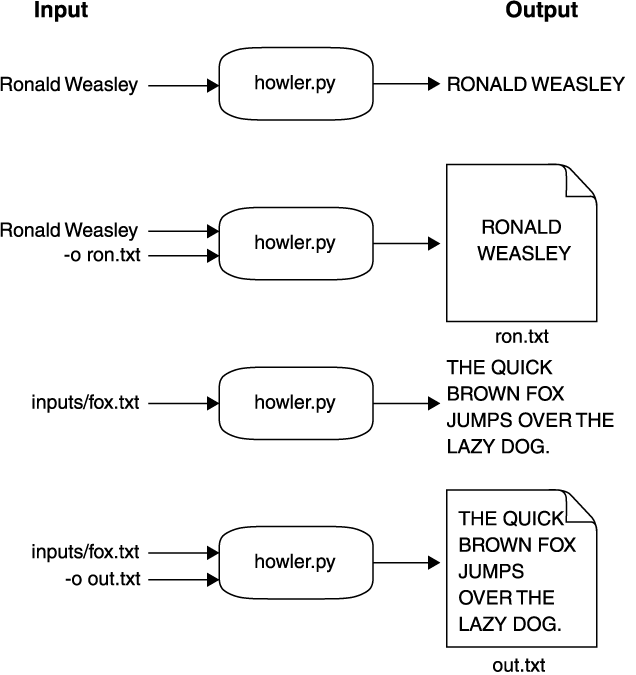
Shows the command-line shape: a string or file input followed by an optional output filename. section 5.3
