An outlier is unusual relative to other observations. In clustering, it is far from the center of every cluster, in contrast to a centroid, which represents a cluster’s center. Sampling a few outliers can surface rare items or trends that clustering may miss, while avoiding a labeling queue dominated by similar examples. section 4.3.1 section 4.3.1
Neural-model scores offer another way to identify outliers. Raw logits retain absolute values that softmax normalizes away, helping distinguish true outliers from items with conflicting information. If logits are unavailable, the second-to-last layer may provide useful scores; exposing logits or retraining only the final layer with Leaky ReLU are alternatives to changing the whole model. section 4.1.2 section 4.1.2
Use outlier sampling sparingly and inspect what the unusual items represent:
- Sample a small number per cluster; they may reveal missed trends, but can instead be genuinely rare or noisy examples. section 4.3.1
- Check whether unusual text contains rare words or unusual images are noisy or corrupted. section 4.3.1
Figure 4.4 An example clustering algorithm applied to the data, splitting it into five separate clusters. For each cluster, the most central item is known as the centroid, and the items farthest from the centers are outliers.
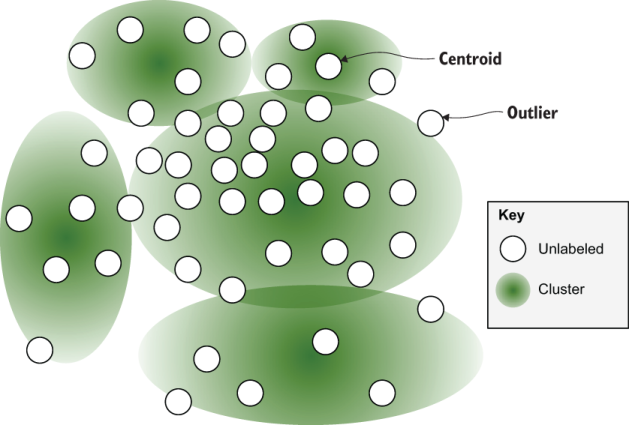
The diagram shows centroids and the items farthest from cluster centers. section 4.3.1