liveBook · Manning

Overwrite

As explained in Architecting an Apache Iceberg Lakehouse

A table write operation that replaces existing data in a specified scope with new data.

Overwrite replaces a subset of an Iceberg table with new data selected by a filter or partition specification. Each operation creates a new snapshot rather than modifying existing data files. section 6.3.1 section 6.3

Use overwrite when the pipeline must:

  • Correct existing data or deterministically reprocess a defined scope. section 6.3.1
  • Refresh a partition, such as a daily snapshot, by replacing its existing files. section 6.3.1
  • Coordinate carefully with other writers, because targeted overwrites can invalidate files within the same scope. section 6.3.1
Figure 6.8 In an overwrite, files with deleted or updated records are replaced with new data files.
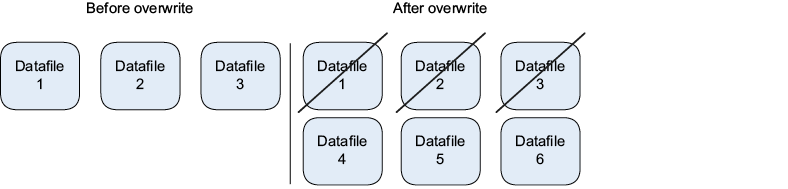
The diagram shows how files containing deleted or updated records are replaced with new data files. section 6.3.1

How Architecting an Apache Iceberg Lakehouse covers it

How deep it goes
Defines scoped replacement and snapshot creation, but stops short of detailed commit-conflict procedures.
Examples
Uses partition-based daily snapshot refreshes and diagrams showing replaced data files.
What you can do after
Apply scoped replacements for corrections or rebuilds while evaluating multiwriter conflict risks.
How it connects
Connects overwrites with snapshots, append operations, copy-on-write, merge-on-read, and concurrent write isolation.

Related concepts

This explainer was generated by Manning's knowledge graph from the text of Architecting an Apache Iceberg Lakehouse. The section links point to the parts of the book it draws on.