liveBook · Manning

P

As explained in Optimization Algorithms: AI techniques for design, planning, and control problems

The complexity class of decision problems solvable in polynomial time by deterministic algorithms.

P is the complexity class of decision problems solvable in polynomial time by deterministic algorithms. It provides a way to classify computational problems by the resources required as input size grows, alongside categories such as NP, NP-hard, and NP-complete. In optimization, recognizing these classes helps distinguish tractable decision procedures from harder search and planning problems. section 2.1.1

Problem classes based on hardness and completeness. Problems can be categorized into NP-hard, NP-complete, NP, or P.
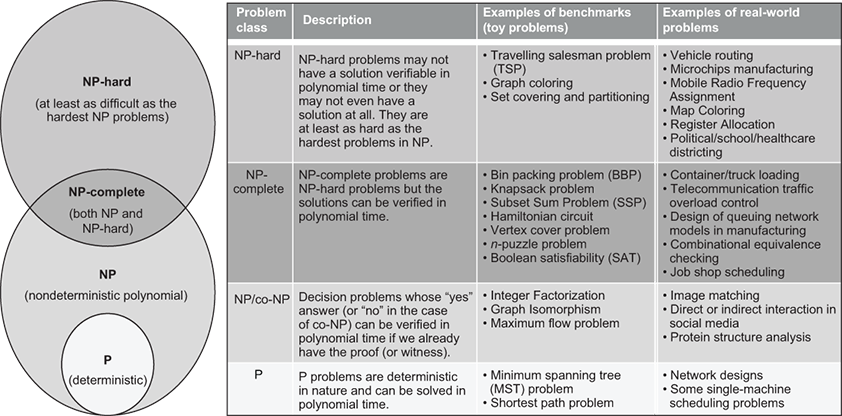
Use the classification diagram to compare P with NP, NP-hard, and NP-complete problem classes when analyzing the computational difficulty of a decision problem. section 2.1.1


How Optimization Algorithms: AI techniques for design, planning, and control problems covers it

How deep it goes
Defines polynomial-time solvability and places P among hardness classes without developing proofs or algorithmic complexity analysis.
What it assumes
Assumes familiarity with decision problems, deterministic algorithms, and polynomial-time growth.
What you can do after
Evaluate whether a decision problem belongs to a polynomial-time complexity class.
How it connects
Connects P with NP, NP-hard, and NP-complete classifications.

Also explained in

Compare how 2 books explain p →

Related concepts

This explainer was generated by Manning's knowledge graph from the text of Optimization Algorithms: AI techniques for design, planning, and control problems. The section links point to the parts of the book it draws on.