A Go package groups Go source files into a named namespace and compilation unit. Every Go program belongs to a package; an executable commonly uses package main with a main function. section 1.3
A minimal executable package
package main import "fmt" func main() { message := "Hello Gophers 👋!" fmt.Println(message) } Initialize a module and run the package with `go mod init github.com/username/repository` followed by `go run .`. section 1.3
Packages become especially useful when an application has distinct responsibilities. A link-shortening service can keep core link-management logic in link and expose HTTP handlers from link/rest. Handlers call the core service rather than duplicating its behavior. section 8.1
Design packages around clarity and genuine boundaries:
- Start with a small, cohesive package when one is sufficient. section 8.8.1
- Split into multiple packages when the application or team grows across domain boundaries. section 8.8.1
- Choose descriptive package and item names that are clear, maintainable, easy to type, and easy to remember. section 8.1
- Reuse standard-library packages for common capabilities such as string manipulation, HTTP servers, command-line flags, and testing. section 1.6
// gobyexample/hello.go
package main  #1

import "fmt"  #2

func main() {
    message := "Hello Gophers 👋!"  #3
    fmt.Println(message)
}
Inspect the complete package main example, including its import and entry point. section 1.3
Figure 8.1 The Shorten and Resolve handlers provide a REST API over HTTP using the Shortener service, which is backed by an in-memory database.
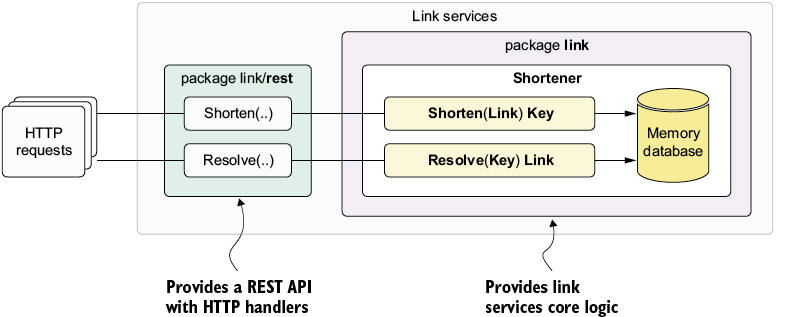
View how separate packages divide HTTP handlers from the in-memory link-shortening service. section 8.1






