A pairwise comparison dataset records which of two alternatives a user prefers. It suits recommendation and preference optimization when choosing between items is easier and more consistent than assigning numerical ratings. section 10.5
Each comparison is represented by a two-element tensor of indices: the first identifies the preferred point in train_x, and the second identifies the non-preferred point. The dataset therefore stores relative outcomes rather than numerical objective values. section 10.2 section 10.5
Encoding two preferences
Suppose a user prefers x = 0 to x = 3 and x = 0 to x = −4. With train_x = [0, 3, −4], train_comp is [[0, 1], [0, 2]]: point 0 wins against points 1 and 2. A helper such as compare() returns [0, 1] when the first objective value is greater, and [1, 0] otherwise. section 10.2
A pairwise comparison dataset can be used to:
- Train a Gaussian process by maximizing the likelihood of observed comparisons. section 10.5
- Represent preferred locations with greater predicted means than locations judged inferior. section 10.5
- Guide Bayesian optimization by comparing the best observed point with a newly recommended candidate. section 10.5
Figure 10.4 Searching for the shirt with the optimal number of flowers in a product recommendation problem. Our search space is one-dimensional since we only search for the number of flowers on a shirt. A shirt that’s more than half covered in flowers is a local optimum, while a shirt that’s almost fully covered maximizes the user’s preference.
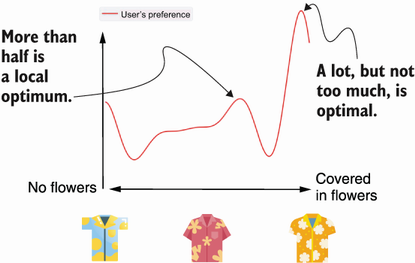
Visualizes a one-dimensional preference search in which a product attribute has both a local optimum and a global optimum. section 10.2
