liveBook · Manning

Pairwise exchange

As explained in Optimization Algorithms: AI techniques for design, planning, and control problems

A pairwise exchange is a neighborhood move that swaps the positions or assignments of two tasks.

A pairwise exchange is a neighborhood move that swaps two task positions in a candidate sequence. In assembly line balancing, the swap is accepted only when precedence constraints remain feasible. section 6.6

Use the move within tabu search as follows:

  • Represent the solution as a task permutation. section 6.6
  • Generate candidate neighbors by exchanging every pair of task positions. section 6.6
  • Discard swaps that violate task precedence, then evaluate the remaining candidates. section 6.6
  • Record the selected exchange in the tabu structure for the specified tenure. section 6.6

Six-task assembly line

With six tasks, exchanging two positions produces at most C(6,2) = 15 neighbors. From [1 2 3 4 5 6], precedence filtering leaves (1-2), (2-3), (3-4), and (5-6) as feasible swaps. Choosing (1-2) yields [2 1 3 4 5 6], and that exchange becomes tabu for three iterations. section 6.6

Figure 6.22 Precedence diagram example for six tasks
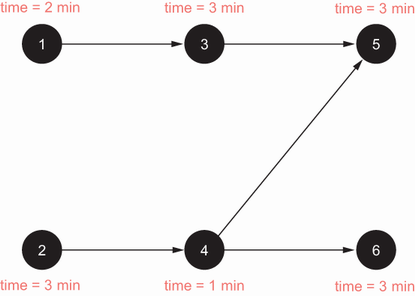
Use the precedence diagram to check whether each exchanged task order remains feasible. section 6.6

How Optimization Algorithms: AI techniques for design, planning, and control problems covers it

How deep it goes
Explains permutation swaps, neighbor counts, precedence filtering, selection, and tabu tenure through hand iterations.
Examples
Uses a six-task permutation, four feasible swaps, a selected exchange, and a three-iteration tabu tenure.
What it assumes
Assumes task precedence and permutation representations while introducing feasibility checks from a small example.
What you can do after
Apply pairwise exchange within a tabu-search implementation for assembly line balancing.
How it connects
Connects tabu search with task permutations, precedence constraints, cycle time, smoothing index, and assembly line balancing.

Related concepts

This explainer was generated by Manning's knowledge graph from the text of Optimization Algorithms: AI techniques for design, planning, and control problems. The section links point to the parts of the book it draws on.