When annotating continuous values, asking people to rank items against one another can be more consistent than asking for absolute scores. Each pairwise task is a binary choice, which can also make quality control easier. section 11.4.3
Pairwise ranking creates more tasks: for 100,000 items, the example estimates 100,000 × log(100,000) comparisons. But each comparison is assumed to take less time and need fewer annotators than a numerical-score task, bringing estimated totals to 1,389 hours versus 1,667. Compare total time and quality-control effort, not just task count. section 11.4.3
Ranking can also reduce anchoring when machine-learning predictions help select comparisons. Annotators may compare items near a predicted score without seeing that score or being told which order to prefer. section 11.4.3
Figure 11.4 An example of using ranking as an alternative to absolute values for a task that requires annotation of continuous values. People are generally much more consistent with one another, and with themselves at different times, when they are asked to rank items instead of give an absolute score.
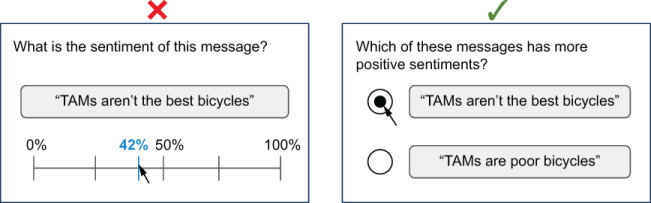
The figure illustrates ranking as an alternative to absolute-value annotation and highlights consistency across annotators and over time. section 11.4.3