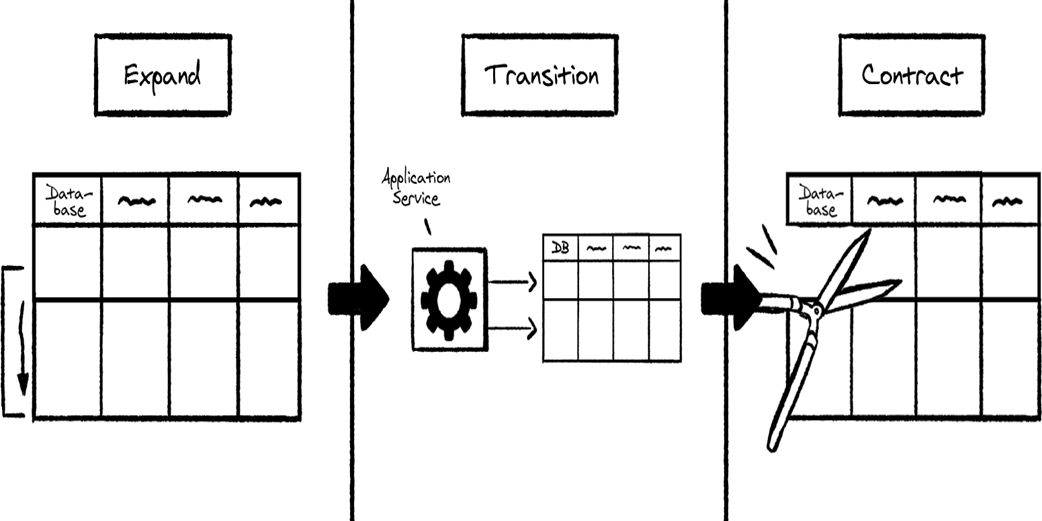
Parallel change, also called the Expand/Contract Pattern, makes breaking database or shared API changes without downtime. Instead of replacing a shared structure in one risky deployment, it keeps old and new versions compatible while the change rolls out. section 13.4.3
Move through three backward-compatible phases:
- Expand: Add the new schema alongside the old one; leave the legacy structure intact. section 13.4.3
- Transition: Deploy code that reads the old path, writes both layouts, and backfills existing records. Protect concurrent writes with deterministic ordering or optimistic concurrency locks. section 13.4.3
- Contract: Remove deprecated structures only after active service instances and data have moved to the new layout. section 13.12 section 13.4.3
Renaming a customer field
To replace customer_phone with phone_mobile, add the new column without deleting the old one. During transition, write both values; an orders insert can populate both columns. Without safe write ordering or concurrency control, an older service instance could overwrite migrated data. section 13.4.3
Figure 13.8 Expand/Contract Pattern: By breaking schema changes into a non-destructive sequence, you ensure backward compatibility and eliminate the risk of database-driven outages.
See how a non-destructive sequence preserves backward compatibility during a schema change. section 13.4.3

