A parallel worlds account answers a counterfactual by holding the observed world as evidence and modeling an alternative world where a causal event changed. It addresses questions such as whether a different decision would have produced a better outcome, rather than merely predicting what usually happens. section 1.2.3 section 8.0
The account separates the worlds and their roles:
- An actual world contains observed event outcomes; a hypothetical world contains no observed outcomes. section 8.4.1
- Potential outcomes are outcomes of the same variable across differing possible worlds. section 8.4.1
- Parallel worlds share common attributes while differing in the causal event under consideration. section 8.4.1
- A parallel world graph represents these worlds and supports counterfactual identification and inference. section 8.4.1
Operationally, construct or derive a generative causal model, condition on evidence from the actual world, apply the alternative action in a hypothetical world, and infer its outcome. Conditioning preserves information about the particular observed case, distinguishing counterfactual distributions from broader interventional distributions. section 9.2 section 9.3.4
Monty Hall: switching after a loss
A player who stayed with the first door and lost can ask whether switching would have won. Build a parallel-world model, condition on the observed outcome in one world, and infer the outcome under switching in the other. The model represents the familiar result that switching wins two times out of three, while also answering the case-specific counterfactual question. section 9.2
Intervention versus counterfactual prediction
For a model that sets femur length to 46 cm, sampling from the intervention model estimates the hypothetical population distribution. Reusing the posterior distribution of exogenous variables from the actual case produces counterfactual samples, which can be narrower because they retain observed-world constraints. section 9.3.4
Figure 9.7 The Monty Hall problem. Assuming the player initially chooses the first door, two out of three times the switching strategy will lead to a win. This illustration assumes the first door is chosen, but the results are the same regardless of the initial choice of door.
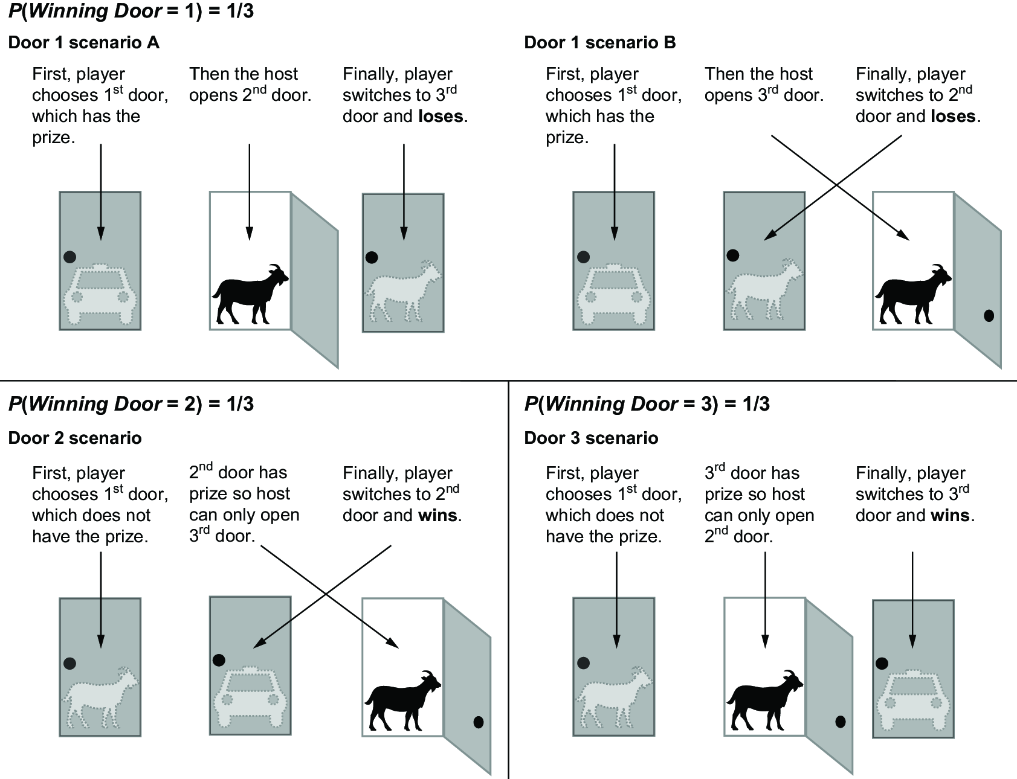
Use the Monty Hall outcome diagram to compare possible switching outcomes and see why switching wins two times out of three. section 9.2
