Part-of-speech tagging assigns grammatical categories to tokens, such as nouns, verbs, adjectives, and punctuation. In a chatbot pipeline, it generates features during text analysis, helping later stages interpret what words are doing. section 1.9
The tags support information extraction by distinguishing likely entities from relations: people, places, and things are often nouns or proper nouns, while verbs can connect entities in a knowledge graph. POS tagging also supports dependency parsing. section 11.4.2
Inspecting tags with spaCy
After processing text with nlp(text), iterate through the first sentence and print each token with its coarse POS category: 'born_VERB ... computer_NOUN scientist_NOUN ... works_VERB ...'. For a tabular inspection, collect TOK, POS, TAG, ENT_TYPE, DEP, and token children in a pandas DataFrame.
Figure 1.8 Example layers for an NLP pipeline
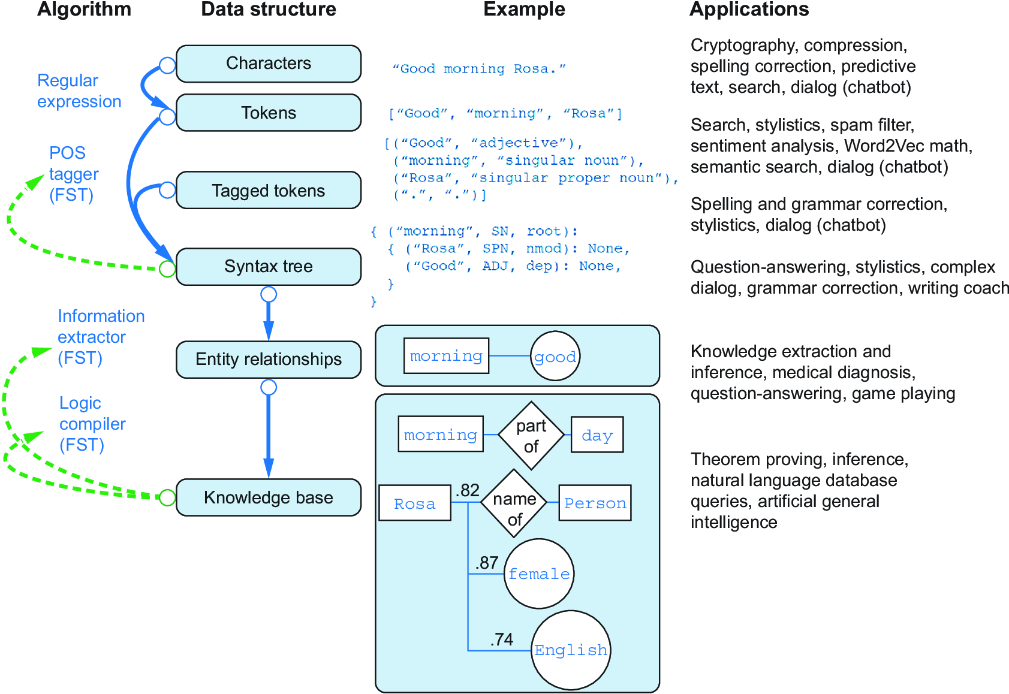
Use the NLP pipeline layers to place POS tagging within feature extraction, feature analysis, entity relationships, and knowledge-base construction. section 1.9
