A partial derivative measures how a multivariable function changes when exactly one variable changes while all others remain constant. For the loss function L(w0, w1) = 2w0² + 3w1², the partial derivatives isolate each parameter’s contribution to loss change. Combining these contributions estimates the total change when several parameters move together. section 3.3.1
A quadratic loss surface
At P = (w0, w1) = (3, 4), the loss is 66 and the gradient is [12, 24]ᵀ. Moving in the opposite direction, [-12, -24]ᵀ, produces the greatest local reduction in loss. This illustrates how individual partial derivatives combine into a direction for changing parameters. section 3.3.1
Figure 3.4 δL in terms of δw in one dimension, illustrated with two example curves: a straight line and a parabola. In general, δL = (dL/dw) δw. To decrease loss, δw must have the opposite sign of the derivative dL/dw. In (a), this implies we always have to move left (decrease w) to decrease L. In (b), if we are in the left half (e.g., point Q), the derivative is negative, and we have to move to the right to decrease L. But if we are in the right half, the derivative is positive, and we have to move to the left to decrease L. Geometrically, this is equivalent to following the tangent “downward.”
|
(a) Line: L(w) = 2w + 1, dL/dw = m |
|
(b) Parabola: L(w) = w2, dL/dw = 2w |
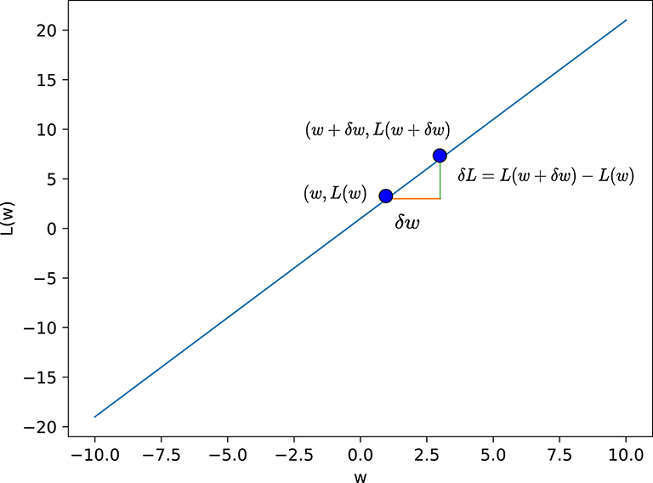
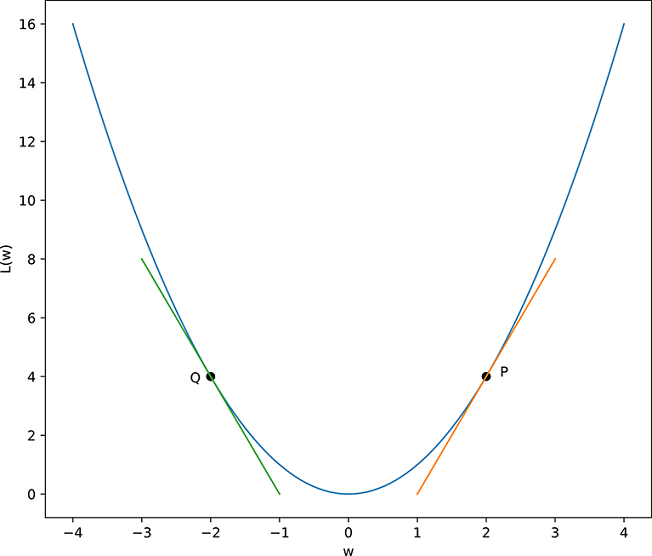
Use the line-and-parabola comparison to connect one-variable derivative direction with the multivariable idea of changing parameters to decrease loss. section 3.3.1


