When a causal query is not identified as a single value, assumptions and data may still identify estimands for its upper and lower bounds. This gives a range of plausible values instead of a point estimate. section 10.9
Bounds can remain useful when full identification is unavailable: causal conclusions may narrow to a sufficiently small region, and machine-learning algorithms can optimize bounds on objective functions. section 10.10 section 10.6.2
A gaming policy experiment
Suppose a randomized treatment encourages players to engage in side quests, and the goal is to estimate how engagement affects in-game purchases. With player characteristics and preferences unobserved, the effect of engagement on purchases is not identified; randomized assignment to the policy can still support partial identification. section 10.9
Figure 10.25 We don’t have identification for the ATE of E on I because G and W are unobserved. But we have partial identification given variable A, representing gamers’ assignments in a randomized experiment.
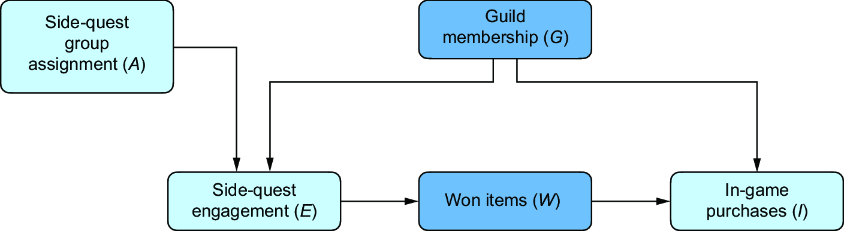
The diagram shows how randomized assignment can support partial identification of the engagement effect when player characteristics and preferences are unobserved. section 10.9
