A partially qualified domain name (PQDN) omits enough DNS hierarchy information to prevent global identification of a host. A hostname such as www identifies a server within business.com but could refer to countless servers elsewhere. section 3.1.3
Key distinctions:
- An FQDN specifies the host’s complete location, such as www.google.com. section 3.1.3
- A trailing dot marks the delimiter between the top-level domain and the nameless root; omitting it makes the name technically partial. section 3.1.3
- PQDNs can contain only partial information, including a device’s configured hostname. section 3.3
Hostname versus complete name
In the DNS context, www is a PQDN when it identifies the web server inside business.com. The corresponding FQDN is www.business.com. Likewise, users commonly type www.google.com without its technically significant final dot. section 3.1.3
Figure 3.3 The DNS hierarchy. All domains are under the root domain, represented by “.”. Under the root domain, there are various top-level domains. Under each top-level domain, there are various second-level domains. The “google” domain, a subtree under the “com” top-level domain, is highlighted.
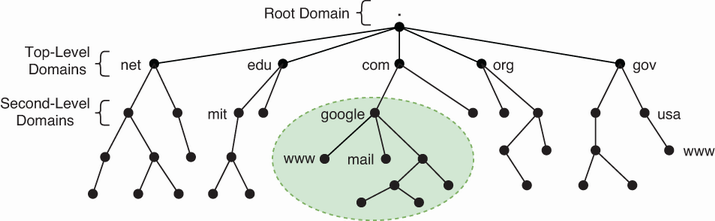
Use the DNS hierarchy to locate the missing information between a hostname, its domain, the top-level domain, and the root. section 3.1.3
