A partner API is an interface exposed to selected external organizations through an established partnership. It enables controlled collaboration without making the API available to everyone. section 1.1.4 section 1.8
A selected-partner Search API
SOCNET exposes a Search API to selected partners willing to pay for access to more data. This contrasts with private Backend and Friends APIs and a public Face Detection API supplied by an external company. section 1.1.4
Designing a partner API requires balancing consumer value with organizational readiness:
- Build design skills through private APIs, because partner APIs often depend on existing private APIs. section 1.3.1
- Use a façade when underlying private APIs contain data, operational, security, or pagination problems. section 1.3.1
- Favor usability, interoperability, and clear behavior to accelerate integrations and time to value. section 1.2.5
Figure 1.4 The terms internal, external, private, partner, and public API may need to be disambiguated so everyone involved understands each other.
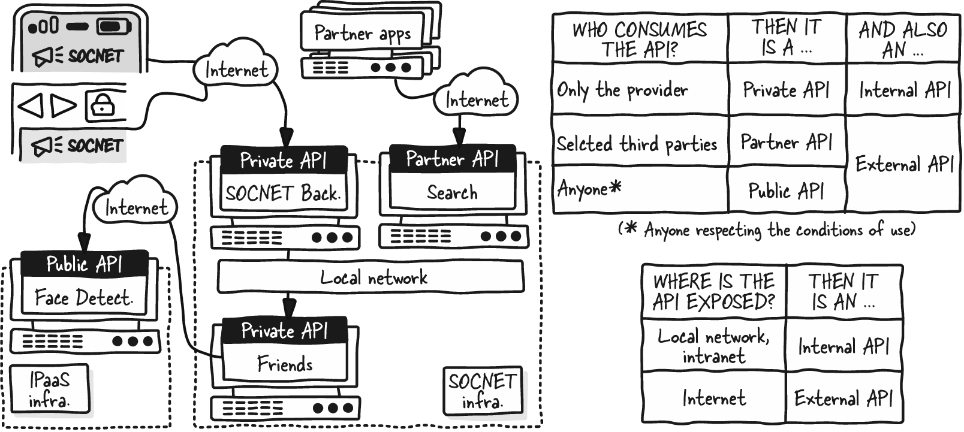
Use the openness-level diagram to distinguish private, partner, public, internal, and external API terminology. section 1.1.4
