Pathway enrichment analysis tests whether dysregulated genes occur disproportionately in predefined biological pathways, helping connect molecular measurements to disease mechanisms. section 13.3.1
A practical target-discovery workflow uses it to:
- Start with differential expression results from patient and control samples. section 13.3.1
- Test which biological pathways are overrepresented among the dysregulated genes. section 13.3.1
- Interpret disease-associated signatures such as ECM remodeling, epithelial-mesenchymal transition, and chronic inflammation. section 13.3.1
Idiopathic pulmonary fibrosis
In IPF, transcriptomic data from patient lung tissue were compared with age-matched controls. Enrichment analysis revealed signatures involving extracellular-matrix remodeling, epithelial-mesenchymal transition, and chronic inflammation, informing subsequent target analysis. section 13.3.1
Figure 13.7 The four stages of the rentosertib program. Multi-omics data and literature flow through PandaOmics to a scored target list; Chemistry42 generates and optimizes candidates against a multi-objective reward; experimental readouts feed back to refine the models; clinical development follows. Sections 13.3.1 through 13.3.4 walk through each stage.
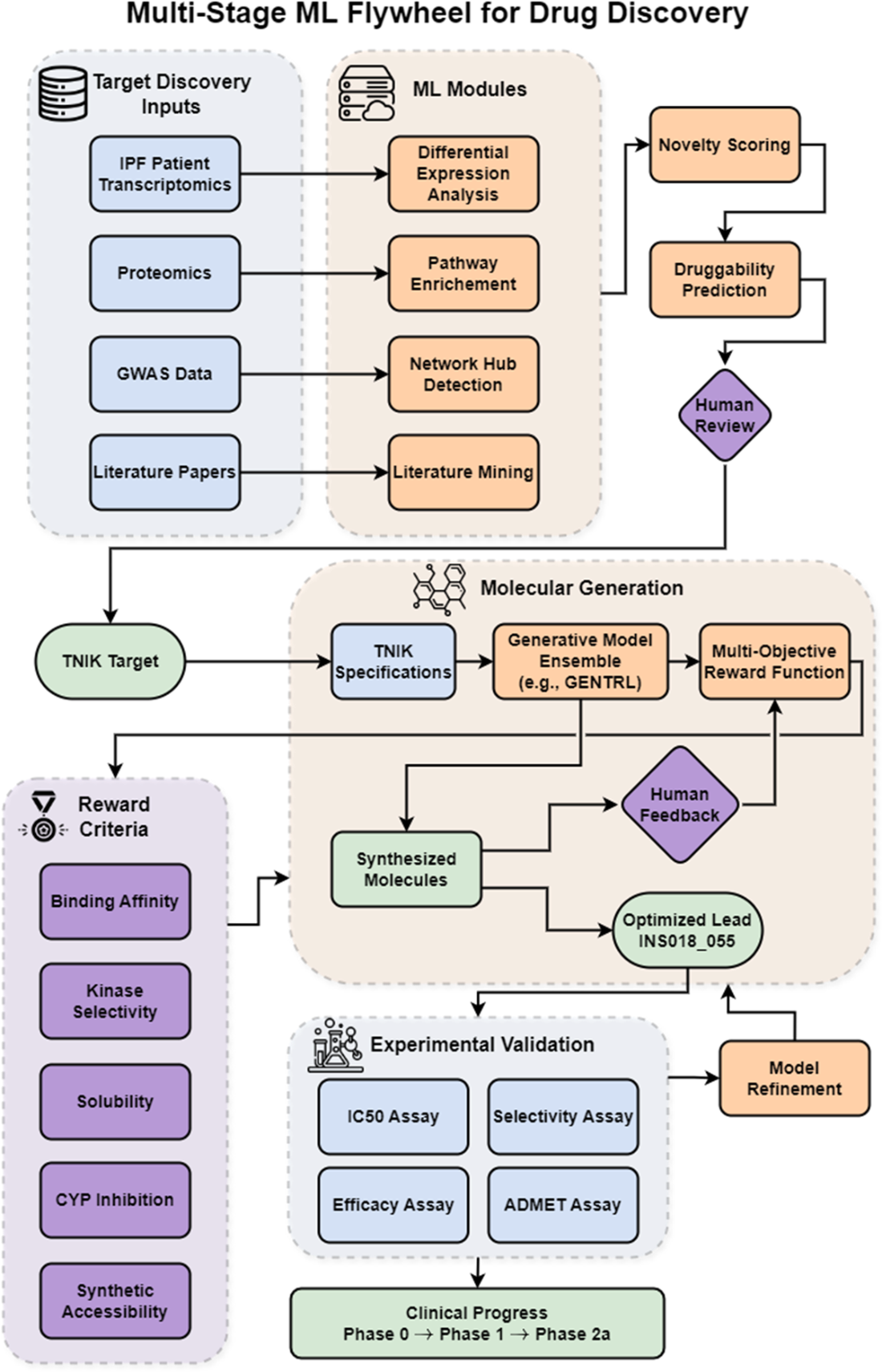
Places pathway enrichment within a multimodal target-discovery pipeline that combines omics data and literature evidence before producing a scored target list. section 13.3.1
